Digital marketing services for Alberta SMBs: 2026 guide
TL;DR:
Digital marketing services are integrated online efforts that attract qualified prospects and convert them into customers across multiple channels.
Most successful Alberta businesses treat these channels as a unified system, connecting efforts to measurable outcomes.
Digital marketing services are defined as integrated online promotional activities that attract qualified prospects and convert them into customers across multiple channels. For small and mid-sized businesses in Alberta, these services cover SEO, paid advertising, content marketing, social media management, marketing automation, and conversion rate optimisation (CRO). The difference between businesses that grow predictably and those that plateau often comes down to whether they treat these channels as a unified system or a collection of disconnected tactics. Marketing Guardians works with Alberta businesses to build that unified system, connecting every channel to measurable outcomes.
What are the essential components of digital marketing services?
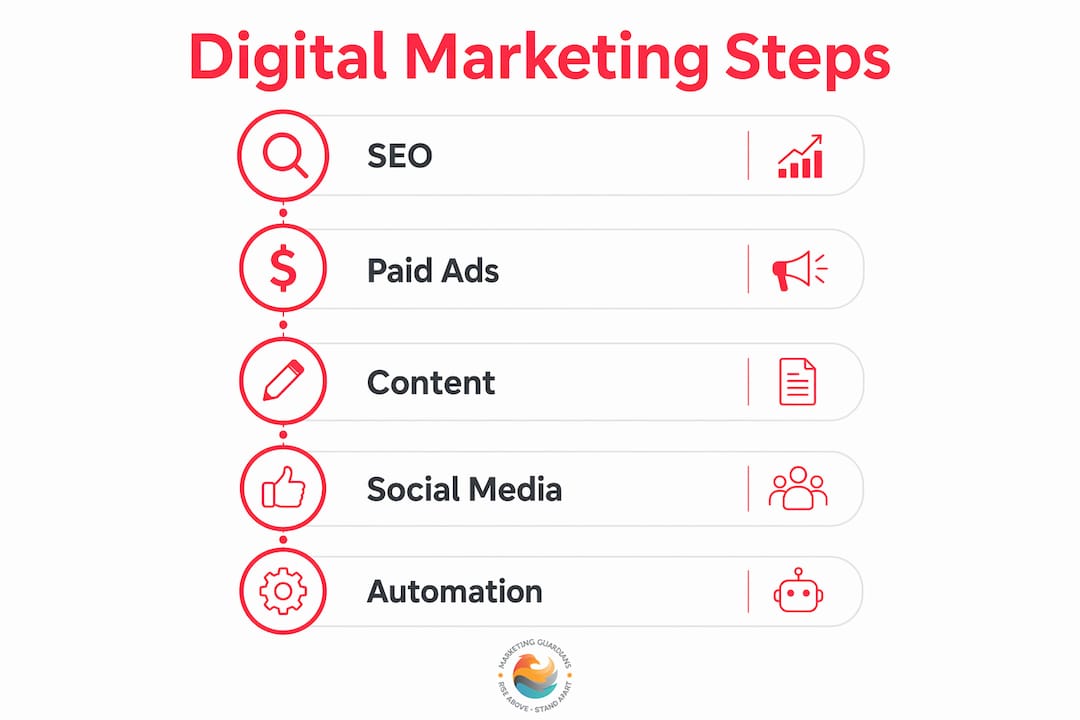
Core digital marketing services encompass SEO, paid advertising, content marketing, social media management, marketing automation, and CRO, all managed under one strategy. Each channel plays a distinct role, but the real value comes when they work together.

SEO builds long-term organic visibility by improving how your website ranks in search results. It generates consistent traffic without paying for every click. Paid advertising (PPC) delivers immediate visibility through platforms like Google Ads and Meta Ads. It is ideal for time-sensitive campaigns or entering new markets quickly. Content marketing creates the material that both SEO and paid ads rely on. Blog posts, guides, and videos answer your customers’ questions and build trust before they ever contact you.
Social media management keeps your brand visible and consistent across platforms like Instagram, Facebook, and LinkedIn. For Alberta businesses, this channel is particularly effective for building local community relationships. Marketing automation connects your campaigns to backend systems so leads flow directly into your CRM and trigger follow-up sequences without manual effort. CRO focuses on improving the percentage of visitors who take a desired action, whether that is filling out a form, calling your office, or making a purchase.
| Service | Primary function | Business benefit |
|---|---|---|
| SEO | Improve organic search rankings | Sustained traffic growth |
| Paid advertising | Drive immediate targeted traffic | Fast lead generation |
| Content marketing | Educate and build trust | Higher conversion rates |
| Social media management | Build brand presence and engagement | Community growth and loyalty |
| Marketing automation | Connect leads to CRM and follow-ups | Reduced manual work, faster response |
| CRO | Improve visitor-to-customer rate | More revenue from existing traffic |
Pro Tip: Do not launch paid advertising before your landing pages are optimised for conversion. Traffic without CRO is money spent on visitors who leave without acting.
How do digital marketing services deliver measurable business results?
The most common mistake Alberta SMBs make is measuring marketing success by clicks and impressions. Successful digital marketing strategies shift focus from vanity metrics to qualified leads, conversion rates, and cost per acquisition (CPA). That shift is what separates marketing spend that feels like a cost from marketing spend that functions like an investment.
Monthly reporting should include clear KPIs tied directly to business outcomes. These include:
-
Qualified leads generated per channel
-
Cost per acquisition (CPA): the total spend divided by the number of new customers
-
Conversion rate: the percentage of visitors who complete a target action
-
Return on ad spend (ROAS): revenue generated per dollar of paid advertising
-
Customer lifetime value (LTV): the total revenue a customer generates over their relationship with your business
Automation integrates marketing with backend systems so leads from SEO, ads, and social channels flow automatically into CRMs and trigger follow-ups without manual effort. Tools like Make.com and n8n make this possible without enterprise-level budgets. That means a small business in Calgary or Edmonton can operate with the same lead-capture efficiency as a much larger organisation.
Integrating digital customer experience and perceived value within digital marketing frameworks leads to demonstrable outcomes like sales growth and market share expansion. This is not a theoretical claim. It reflects what happens when every touchpoint, from the first Google search to the follow-up email, is designed as part of a single customer experience rather than a series of isolated interactions.
How to build a digital marketing strategy for your SMB
A clear strategy prevents wasted budget. Without one, businesses tend to chase tactics rather than results. The following steps give Alberta SMBs a practical starting point.
-
Define your audience. Identify who your best customers are, where they spend time online, and what problems they are trying to solve. Use this to determine which channels deserve your attention first.
-
Select your channels based on evidence, not trend. If your customers search Google before buying, SEO and PPC belong in your plan. If they engage heavily on Instagram, social media management becomes a priority.
-
Apply the 70/20/10 budget model. Small businesses should allocate 70% of their digital marketing budget to proven strategies, 20% to promising tactics, and 10% to experimentation. This framework balances reliable returns with the flexibility to test new approaches without risking your core budget.
-
Set KPIs before you launch. Agree on what success looks like before spending a dollar. Define your target CPA, conversion rate, and lead volume for each channel.
-
Review and adapt monthly. Digital channels shift quickly. A monthly performance review lets you reallocate budget away from underperforming channels and toward what is working.
-
Integrate your tools. Connect your CRM, advertising platforms, and analytics into one reporting view. Operating with disconnected data is the equivalent of driving without a dashboard.
Pro Tip: Start with two or three channels and do them well before expanding. Spreading a limited budget across six channels produces mediocre results on all of them.
Digital marketing promotes brands through channels including web, social media, paid ads, and email, and requires multi-channel orchestration for best results. That orchestration is where most SMBs struggle, and where a clear strategy pays for itself.
What challenges come with managing integrated digital marketing?
Integration is the goal, but it is also where most campaigns break down. Common pitfalls include siloed campaigns, inconsistent messaging, and lack of integrated reporting, all of which reduce marketing effectiveness. Recognising these challenges early prevents the kind of wasted spend that discourages business owners from investing in online marketing at all.
The most frequent issues Alberta SMBs encounter include:
-
Siloed campaigns: SEO, paid ads, and social media run independently with no shared strategy or messaging. Each team or vendor optimises for their own metrics rather than shared business outcomes.
-
Inconsistent brand messaging: Your Google ad promises one thing, your landing page says another, and your social media posts feel like they belong to a different company entirely. This erodes trust quickly.
-
Data silos: Analytics live in separate platforms with no unified view. Without consolidated reporting, you cannot see which channels are actually driving revenue.
-
Slow response to leads: Without automation, leads captured through ads or organic search wait hours or days for follow-up. Response time directly affects conversion rates.
Best practices that address these challenges include unified campaign planning across all channels, integrated reporting dashboards that consolidate data from every platform, and automation workflows that eliminate manual handoffs. Marketing is repositioned as a systematic approach to competitive performance enhancement when these practices are in place. That repositioning matters for Alberta businesses competing in markets where larger organisations have more resources but not necessarily better strategy.
Cross-channel synergy also requires consistent creative assets and messaging guidelines. When your SEO content, paid ad copy, and social media posts all reflect the same brand voice and value proposition, each channel reinforces the others. That compounding effect is what turns a collection of online marketing services into a growth system.
Key takeaways
Effective digital marketing services function as a unified system, not a set of isolated tactics, and success is measured by qualified leads, CPA, and LTV rather than clicks or impressions.
| Point | Details |
|---|---|
| Integration drives results | SEO, paid ads, content, and automation must connect under one strategy to produce consistent ROI. |
| KPIs over vanity metrics | Measure qualified leads, CPA, and conversion rates rather than clicks and impressions. |
| 70/20/10 budget model | Allocate 70% to proven channels, 20% to promising tactics, and 10% to experimentation. |
| Automation closes the gap | Tools like Make.com and n8n connect leads to CRMs automatically, reducing response time. |
| Siloed campaigns cost money | Inconsistent messaging and disconnected data reduce effectiveness across every channel. |
The case for treating marketing as a system, not a service list
We have worked with enough Alberta businesses to know that the biggest obstacle is not budget. It is perspective. Most business owners approach online marketing services as a menu: pick SEO, add some social media, maybe run a few ads. The results are predictably inconsistent because no single channel is designed to carry the full weight of customer acquisition on its own.
The businesses that grow steadily are the ones that treat marketing as a system where every channel feeds the next. Their SEO content attracts organic traffic. Their retargeting ads bring back visitors who did not convert. Their automation follows up with leads before a competitor does. Their monthly reporting tells them exactly where to put the next dollar. That is not a complicated idea, but it requires discipline and a willingness to measure what actually matters.
The technology side of this has become genuinely accessible for SMBs. Automation tools that once required enterprise budgets now work for businesses with modest monthly spend. The gap between large and small organisations in terms of marketing capability has narrowed significantly. What has not changed is the need for a clear strategy that connects all the pieces.
Marketing experts view integration as a key driver for improving customer digital interactions and expanding market position. We agree, and we would add that integration without measurement is still operating in the dark. The combination of connected channels and clear KPIs is what makes digital marketing a reliable growth driver rather than an unpredictable expense.
Stephen Ramkissoon, CEO at Marketing Guardians
How Marketing Guardians supports Alberta businesses with integrated digital marketing
Alberta businesses that want consistent growth without hiring a full internal marketing team have a clear option. Marketing Guardians delivers integrated digital marketing services through a subscription model that covers SEO, PPC, social media management, content creation, and marketing automation under one coordinated strategy.
Every client engagement starts with understanding your business goals, your audience, and your current performance baseline. From there, Marketing Guardians builds a plan that connects your channels, integrates your tools, and reports on the KPIs that actually reflect business growth. You stay focused on running your business. We handle the marketing execution, the reporting, and the ongoing adjustments that keep results moving in the right direction. Visit Marketing Guardians to learn how we can build a system that works for your Alberta business.
FAQ
What are digital marketing services?
Digital marketing services are integrated online promotional activities that include SEO, paid advertising, content marketing, social media management, marketing automation, and CRO. They are designed to attract qualified prospects and convert them into customers through coordinated multi-channel strategies.
How much should an Alberta SMB spend on digital marketing?
The 70/20/10 budget model is the most practical framework for small and mid-sized businesses. Allocate 70% to proven channels, 20% to promising tactics, and 10% to testing new approaches.
What metrics should I track for digital marketing?
Track qualified leads, cost per acquisition (CPA), conversion rate, return on ad spend (ROAS), and customer lifetime value (LTV). Clicks and impressions are secondary indicators, not measures of business growth.
How does marketing automation improve results?
Automation connects leads from SEO, paid ads, and social media directly into your CRM and triggers follow-up sequences without manual effort. Tools like Make.com and n8n make this accessible for businesses without large marketing teams.
Why do siloed campaigns underperform?
Siloed campaigns run without a shared strategy, which produces inconsistent messaging and disconnected data. Without integrated reporting, you cannot identify which channels are driving revenue or where to reallocate budget.