TL;DR:
- Google display advertising uses visual ads across the Google Display Network to increase brand awareness and engagement.
- Active management, precise targeting, and high-quality creative are essential to achieving positive ROI.
Display advertising on Google is defined as placing visual ads, including banners, responsive ads, and rich media, across the Google Display Network (GDN) to build brand awareness and drive customer engagement. The GDN reaches over 90% of global internet users across 35 million websites and apps. That scale makes it one of the most far-reaching paid media channels available to small and mid-sized businesses in Alberta. Whether you run a Calgary retail shop or an Edmonton service firm, display advertising on Google puts your brand in front of potential customers while they browse, read, and watch content online.
How does display advertising on Google work?
The Google Display Network places your ads across websites, apps, YouTube, Gmail, and Google Discover. Google acts as the intermediary, matching your ads to relevant placements based on the targeting signals you set. The result is your brand appearing in front of the right people, at the right moment, without requiring a direct search query.

Ad formats available on the GDN
Google supports several ad formats, each suited to different goals:
- Responsive display ads (RDAs): You upload headlines, descriptions, images, and logos. Google assembles and tests combinations automatically. Responsive display ads outperform static banners by adapting to every placement size and context.
- Static banners: Fixed image ads in standard IAB sizes (e.g., 300x250, 728x90). They offer full creative control but require manual resizing.
- HTML5 ads: Animated, interactive ads built in Google Web Designer. They perform well for product launches and event promotions.
- Video ads: Short clips served on YouTube and partner sites, ideal for brand storytelling.
Targeting options that define your audience
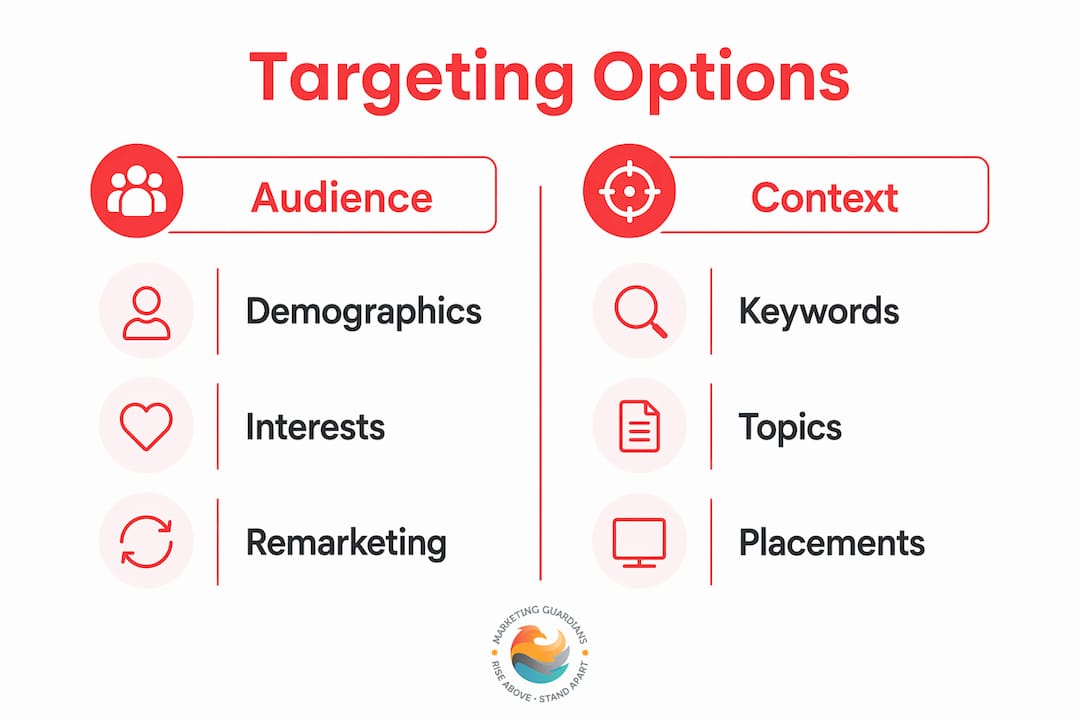
Google display ads offer several targeting methods. The most effective campaigns combine more than one:
- Audience-based targeting: Reach users by demographics, interests, or in-market behaviour. Google’s audience segments include categories like “home improvement” or “financial services.”
- Contextual targeting: Match ads to pages whose content aligns with your keywords or topics.
- Placement targeting: Choose specific websites or apps where your ads appear.
- Remarketing: Show ads to people who have already visited your website or engaged with your brand.
Google’s Smart Bidding uses machine learning to adjust bids in real time, factoring in device, location, time of day, and audience signals. For Alberta businesses with limited budgets, Smart Bidding reduces manual effort while keeping cost per acquisition (CPA) in check.
What are the best practices for Google display campaigns?
Running a display campaign without active management is the fastest way to waste budget. Default GDN settings can burn 20–40% of ad spend without meaningful returns, because Google’s broad defaults serve ads across low-quality placements and irrelevant apps.
Follow these steps to build a well-managed campaign from the start:
- Exclude mobile app placements immediately. Mobile apps generate high accidental click rates and bot traffic. Excluding mobile apps can lift conversion rates by 30–50%. Go to Placements > Exclusions and add the mobile app category on day one.
- Exclude parked domains and sensitive content. Parked domains serve no real audience. Sensitive content categories (gambling, tragedy, etc.) can damage brand reputation and attract irrelevant clicks.
- Combine targeting methods with “and” logic. Stacking an in-market audience with contextual keywords narrows your reach to users who are both interested in your category and actively reading relevant content. This produces more qualified impressions.
- Set frequency caps. Without a cap, a single user can see your ad dozens of times per day. A frequency of 3–5 impressions per user per day is a reasonable starting point for most Alberta businesses.
- Review placement reports weekly. Google will find new placements over time. Some will be irrelevant. Regular exclusion updates protect your budget and your brand’s reputation.
Pro Tip: Upload at least five headlines, five descriptions, and ten images when building a responsive display ad. More assets give Google more combinations to test, which improves performance over time.
Creative quality is not optional. A well-targeted ad with a weak image and vague headline will underperform a moderately targeted ad with a clear value proposition and strong visual. For Alberta businesses competing in crowded markets, your creative is your first impression.
How do you measure the ROI of Google display ads?
Measuring display ad performance requires a different mindset than search advertising. Display ads build awareness and influence decisions before a user searches or converts. Last-click attribution, the default in many accounts, assigns zero credit to display ads when a user converts later through a different channel. That model consistently undervalues display’s contribution.
Understanding view-through conversions
A view-through conversion occurs when a user sees your display ad, does not click, but later converts on your website. Google tracks this in your conversion column. View-through conversions indicate that your ad influenced the decision, even without a direct click. They are not a perfect metric, but they provide a signal that your brand is present during the consideration phase.
Why incrementality testing matters
Incrementality testing compares conversion rates between an audience exposed to your ads and a holdout group that was not. The difference in conversion rate represents the true lift your campaign delivered. Standard conversion tracking often over-estimates or under-estimates this lift. For Alberta businesses spending meaningful budgets on display, running a holdout test every quarter gives you a clearer picture of actual ROI.
| Measurement method | What it measures | Limitation |
|---|---|---|
| Last-click attribution | Final touchpoint before conversion | Ignores display’s role in awareness |
| View-through conversions | Post-impression conversions | Can double-count with other channels |
| Multi-touch attribution | Credit across all touchpoints | Requires more data and setup |
| Incrementality testing | True lift from ad exposure | Needs sufficient audience volume |
Focus on CPA and conversion rate as your primary performance indicators. Click-through rate (CTR) on display is typically low by design. A CTR below 0.5% is normal and does not indicate a failing campaign.
What is Google Demand Gen, and how does it change display advertising?
Google is transitioning traditional Display campaigns into AI-powered Demand Gen campaigns, with the migration completing by 2027. Demand Gen unifies ad delivery across YouTube, Gmail, Google Discover, and the GDN under a single campaign type. The shift reflects how consumers now move across multiple Google properties before making a purchase decision.
Key changes Demand Gen brings to display advertising:
- Broader reach with less manual setup. Demand Gen uses Google’s AI to find audiences across properties, reducing the need to manage separate campaigns for each channel.
- Improved ROI. Adding GDN inventory within Demand Gen campaigns produces an average 9.5% ROI increase compared to traditional display campaigns alone.
- Unified creative management. You upload assets once and Google adapts them across YouTube Shorts, in-feed ads, Gmail, and display placements.
- Lookalike audience expansion. Demand Gen includes lookalike segments based on your existing customer lists, a feature not available in standard display campaigns.
For Alberta businesses currently running traditional display campaigns, the migration path is straightforward. Google provides guided migration tools within Google Ads. The most important preparation step is auditing your creative assets before migration, because Demand Gen requires video assets alongside images for full placement coverage.
Key takeaways
Display advertising on Google delivers the broadest paid media reach available, but only when campaigns are actively managed with precise targeting, strong creative, and proper measurement.
| Point | Details |
|---|---|
| Scale of the GDN | The network reaches over 90% of global internet users across 35 million+ sites and apps. |
| Placement hygiene is critical | Excluding mobile apps alone can improve conversion rates by 30–50%. |
| Default settings waste budget | Unoptimized campaigns can burn 20–40% of spend on low-quality placements. |
| Measure beyond last-click | Use view-through conversions and incrementality testing for accurate ROI assessment. |
| Demand Gen is the future | Google’s AI-powered Demand Gen campaigns deliver a 9.5% average ROI lift over traditional display. |
What I’ve learned from watching Alberta businesses run display ads
The single most common mistake I see from small and mid-sized business owners in Alberta is treating display campaigns as passive. They set a budget, choose a broad audience, and check back in a month. By then, a significant portion of that budget has gone to mobile game apps and parked domains that no real customer ever reads.
Remarketing campaigns consistently deliver the highest ROI on the GDN because they target people who already know your brand. A plumbing company in Red Deer that shows display ads to people who visited their service pages but did not call will outperform a cold-audience campaign every time. The audience has already shown intent. The ad just needs to bring them back.
Creative quality is where most campaigns quietly fail. I have seen businesses spend weeks debating audience targeting while using a blurry logo on a white background as their ad image. The creative is what the user actually sees. A clear headline, a relevant image, and a direct call to action will outperform sophisticated targeting paired with weak visuals.
The network’s scale is both its strength and its risk. Reaching 90% of internet users sounds impressive. Without precise targeting and regular exclusion management, that reach becomes noise. The businesses that win on display treat it like a garden: they plant carefully, prune regularly, and pay attention to what is growing.
— Stephen Ramkissoon
How Marketing Guardians supports your display advertising goals
Running Google display campaigns well requires consistent attention, creative discipline, and data-driven decisions. For Alberta business owners who want results without managing every detail themselves, Marketing Guardians provides subscription-based digital marketing services built around your specific goals.

Marketing Guardians handles campaign setup, placement exclusions, creative guidance, and performance reporting so you can focus on running your business. Beyond display advertising, we also help protect your ad spend and website quality through solutions like reCAPTCHA integration, which filters bot traffic and improves the accuracy of your conversion data. Clean traffic means cleaner data, and cleaner data means better decisions. Reach out to Marketing Guardians to see how a structured, managed approach to display advertising can work for your Alberta business.
FAQ
What is the Google Display Network?
The Google Display Network is a collection of over 35 million websites, apps, and Google-owned properties where display ads are served. It reaches over 90% of global internet users.
How much does display advertising on Google cost?
Google display ads operate on a cost-per-click (CPC) or cost-per-thousand-impressions (CPM) model, with budgets set by the advertiser. Costs vary by industry, targeting, and competition, and there is no publicly listed minimum spend.
Why are my Google display ads not converting?
Low conversion rates on display ads are most often caused by poor placement hygiene, weak creative assets, or missing remarketing audiences. Excluding mobile app placements and tightening audience targeting are the first steps to address.
What is the difference between display ads and search ads?
Search ads appear when users actively search for a keyword. Display ads appear while users browse websites and apps, making them better suited for brand awareness and remarketing rather than capturing immediate purchase intent.
What is a Demand Gen campaign?
Demand Gen is Google’s AI-powered campaign type that serves ads across YouTube, Gmail, Google Discover, and the GDN from a single campaign. Google is migrating traditional display campaigns to Demand Gen by 2027.

Get Your Free Guide
Download our comprehensive guide to improve your marketing strategy.


