
TL;DR:
- Google I/O 2026 emphasizes integrating AI as the foundation of marketing infrastructure, not just an added feature.
- Canadian businesses should prioritize initial experiments, ensure PIPEDA compliance, and map API data flows within 30 days.
Google I/O is the annual developer conference that functions as Google’s infrastructure roadmap. The 2026 edition signals one clear shift for Canadian marketers: AI is no longer a feature you bolt onto a campaign. It is the layer your entire marketing stack will run on. Here is what to do right now.
Three immediate next steps:
- Scan the official session recordings and identify which Gemini API or Vertex AI capability maps to your current lead-generation workflow.
- Identify one to two experiments to run, specifically a Google Ads creative test and a Generative Engine Optimisation (GEO) monitoring baseline.
- Confirm your data governance posture for Canadian compliance before connecting any new API to customer data.
Marketing Guardians works with Canadian businesses to translate exactly these kinds of platform shifts into subscription-based marketing programmes built around Google Ads, Google Analytics 4 (GA4), and Google Cloud / Vertex AI.
Table of Contents
- What did Google I/O 2026 actually announce for marketers?
- How do these announcements affect your marketing and lead generation?
- What does a practical 30/90/180-day post-I/O roadmap look like?
- What should you measure and how should you structure your tests?
- How can subscription agencies operationalise I/O findings for clients?
- Key takeaways
- Why the sequencing matters more than the technology
- Marketing Guardians can help you act on Google I/O findings
- Useful sources
- FAQ
What did Google I/O 2026 actually announce for marketers?
Google I/O is Google’s annual developer conference, combining keynotes, workshops, codelabs, and an expo floor. The 2026 edition ran May 19–20 and placed agentic AI at the centre of every major announcement. The developer keynote framed the shift explicitly: agents that independently navigate complex tasks are now the primary product paradigm, not isolated AI features.
The headline announcements that directly affect marketing teams:
- Gemini 3.5 Flash: A frontier model optimised for speed and agentic workflows, running four times faster than comparable frontier models. For marketers, this means real-time creative generation and faster ad iteration cycles become practical.
- Antigravity 2.0: A standalone agent platform that orchestrates multiple agents in parallel, with scheduled background tasks and integrations across Google AI Studio, Android, and Firebase. Marketing implication: automated prospecting and follow-up sequences can now be built on production-grade infrastructure.
- Managed Agents in the Gemini API: A single API call spins up an agent that reasons, uses tools, and executes code. This lowers the technical barrier for agencies building agentic lead-nurture flows.
- AI Mode in Google Search: Reached 1 billion users, fundamentally changing how search results are surfaced and how GEO monitoring must be structured.
- Workspace integration: Agents can now natively call Google Workspace APIs, opening direct connections between marketing automation and sales workflows in Gmail, Docs, and Sheets.
Google published more than 85 on-demand sessions and codelabs after the event. That volume means your team does not need to watch everything; it means you need a prioritisation framework.
Pro Tip: Start with the Gemini API and Antigravity sessions before the Search or Ads sessions. Infrastructure decisions made at the API layer will constrain or enable everything else downstream.

How do these announcements affect your marketing and lead generation?
The shift from AI-as-tool to AI-as-infrastructure creates both opportunities and risks that Canadian marketing teams need to weigh carefully.
Opportunities worth prioritising:
- Agentic workflows for lead nurturing: Antigravity 2.0 and Managed Agents make it feasible to automate the lead-capture-to-qualification sequence without custom engineering.
- Generative creative at scale: Gemini 3.5 Flash’s speed makes A/B testing ad creative variants faster and cheaper than manual production.
- Richer SERP experiences: AI Mode’s reach means understanding AI search mechanics is now a baseline competency, not a specialist skill.
- Workspace-connected sales workflows: native API integration between agents and Workspace tools reduces the friction between marketing automation and CRM-style follow-up.
Risks to manage:
- Automation bias: agentic systems can optimise for the wrong metric if KPIs are not precisely defined before deployment.
- Creative authenticity: generative content at scale requires brand-voice guardrails and human review checkpoints.
- GEO impact: as AI Mode reshapes how results are surfaced, organic visibility metrics in GA4 may shift in ways that look like performance drops but are actually measurement gaps.
For Canadian businesses, data residency is the compliance issue that surfaces first. PIPEDA requires that personal data used in automated decision-making be handled with transparency and consent. Before connecting any Gemini API or Vertex AI workflow to customer data, confirm that your Google Cloud region is set to a Canadian or contractually compliant data centre, and document the data flows.
Agentic workflows require clear orchestration patterns and observability; pilots should include fallbacks and human-in-the-loop checkpoints to manage quality and compliance.
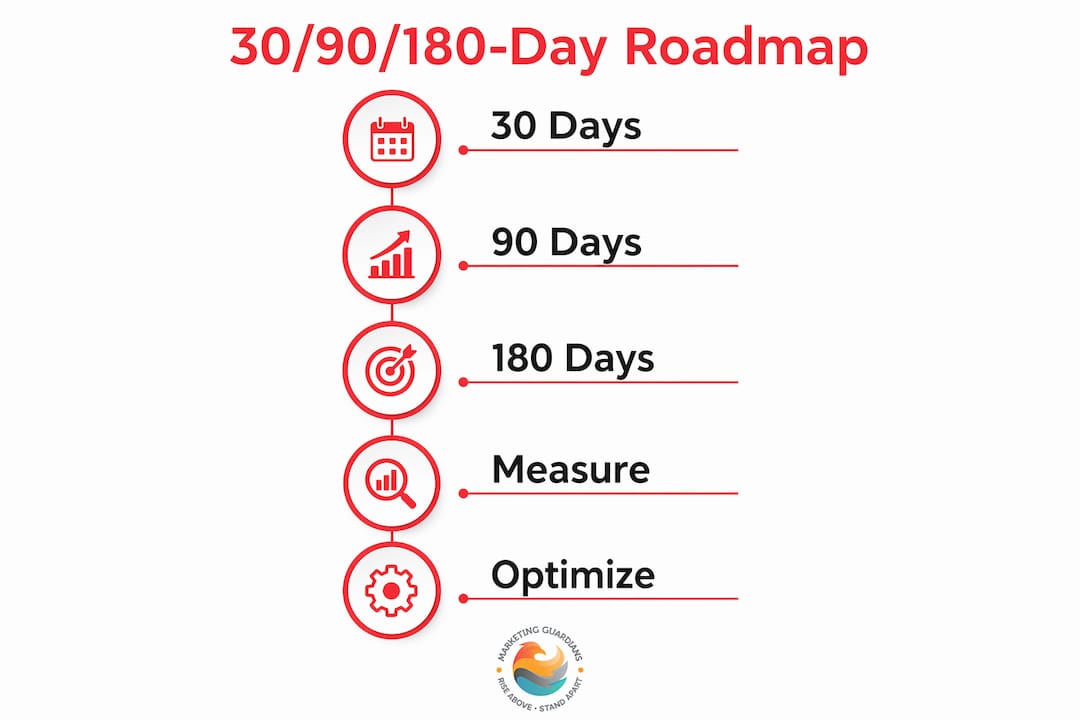
What does a practical 30/90/180-day post-I/O roadmap look like?
30 days — rapid audit:
- Prioritise three sessions from the Google I/O session index: Gemini API overview, Antigravity 2.0 architecture, and AI Mode in Search.
- Identify one low-risk experiment: a Gemini-powered ad creative test in Google Ads or a Search-rich snippet optimisation.
- Map your current data flows to GA4 and document any gaps against PIPEDA requirements.
90 days — pilot execution:
- Deploy your chosen experiment with a defined A/B test structure and a GEO monitoring baseline.
- Integrate limited agentic automation for one prospecting or follow-up sequence using Managed Agents.
- Measure weekly against pre-defined KPIs: lead volume, cost-per-acquisition (CPA), and conversion rate per channel.
180 days — scale and operationalise:
- Migrate successful pilots into your subscription service offerings or agency retainer scope.
- Optimise infrastructure costs by selecting the right Google Cloud / Vertex AI tier for your actual usage volume.
- Set service-level agreements (SLAs) for ongoing monitoring of GEO metrics and GA4 event accuracy.
Pro Tip: Use Marketing Guardians’ Website Project Planner to map API integration points against your existing web infrastructure before the 30-day audit is complete.
What should you measure and how should you structure your tests?
The highest-leverage post-I/O follow-up is mapping new APIs to existing customer journeys and instrumenting each handover with GA4 events. Without that instrumentation, you are operating without visibility into where agentic workflows add or lose value.
Primary KPIs for post-I/O experiments:
| KPI | What it measures | Baseline source |
|---|---|---|
| Lead volume by channel | Total qualified leads per source | GA4 acquisition report |
| Conversion rate | Leads to opportunities | GA4 funnel exploration |
| Cost-per-acquisition (CPA) | Spend per converted lead | Google Ads experiment data |
| Time-to-contact | Speed of agentic follow-up | CRM or Workspace log |
| LTV shift | Revenue change with agentic nurture | CRM cohort comparison |
For GEO monitoring, establish a baseline of your brand’s appearance in AI-generated search results before deploying any new content or API-driven pages. Track changes weekly for the first 90 days. Our GEO monitoring guidance covers the specific metrics and A/B test structures that work for AI-driven SERP changes.
For Google Ads experiments, use the native experiment tool to split traffic between your current creative and Gemini-generated variants. Run each test for a minimum of four weeks to reach statistical validity before drawing conclusions.
Pro Tip: Map every agentic workflow handover point as a discrete GA4 event. If you cannot see where a lead transitions from automated nurture to human follow-up, you cannot attribute revenue accurately.
How can subscription agencies operationalise I/O findings for clients?
| Service path | Marketing impact | Implementation complexity | Required resources | Expected timeline | Cost shape |
|---|---|---|---|---|---|
| Entry pilot | Low to medium | Low | 1 marketer, existing Google Ads account | 30 days | Fixed project fee |
| Co-managed pilot | Medium to high | Medium | Agency + client marketing ops | 90 days | Shared monthly subscription |
| Managed subscription | High | High | Full agency team, GA4, Cloud/Vertex AI | 90–180 days | Recurring monthly subscription |
The decision between paths comes down to three questions: Does your team have the technical capacity to instrument GA4 events and manage API credentials? Do you have a defined experiment hypothesis and success metric? And is your data governance documentation current?
For marketers, the highest-leverage I/O follow-ups are mapping new APIs to existing customer journeys and instrumenting each handover with GA4 events.
Marketing Guardians structures its subscription offerings to absorb exactly this kind of platform transition, moving clients from entry pilots to managed subscriptions as experiments prove out. The PALC case study illustrates how a structured pilot converted into a recurring engagement with measurable lead-generation improvements.
Key takeaways
Google I/O 2026 establishes AI as marketing infrastructure, and Canadian businesses that act within 30 days on a defined experiment will be positioned ahead of teams that wait for the technology to mature further.
| Point | Details |
|---|---|
| AI is now infrastructure | Gemini 3.5 Flash and Antigravity 2.0 make agentic marketing workflows production-ready, not experimental. |
| AI Mode reached 1 billion users | GEO monitoring is now a baseline requirement, not an optional add-on, for any Canadian business relying on organic search. |
| PIPEDA compliance comes first | Map data flows and confirm Canadian data residency before connecting any Gemini API to customer data. |
| 30-day audit is the critical first step | Prioritise three sessions, define one experiment, and instrument GA4 before any pilot deployment. |
| Marketing Guardians | Offers subscription-based pilots and managed programmes to operationalise I/O findings for Canadian businesses. |
Why the sequencing matters more than the technology
The conventional wisdom after any major developer conference is to chase the shiniest announcement. After Google I/O 2026, that instinct points toward Gemini 3.5 Flash and Antigravity 2.0, and those tools genuinely are significant. But the businesses that will extract the most value from this cycle are not the ones that deploy the newest API fastest. They are the ones that define a clear measurement baseline before they touch anything new.
AI Mode reaching 1 billion users is not primarily a search story. It is a measurement story. If your GA4 configuration was built for a world where users click blue links, it will misattribute a growing share of your traffic and conversions as AI-driven interfaces become the default. Fixing that instrumentation gap is less exciting than launching a Gemini-powered ad creative test, but it is the work that makes every subsequent experiment interpretable.
The same logic applies to agentic workflows. Antigravity 2.0 is genuinely capable of automating lead-nurture sequences end-to-end. But an agent without human-in-the-loop checkpoints and observable handover events is a liability, not an asset, particularly under PIPEDA’s transparency requirements. The agencies and marketing teams that will win this cycle are the ones that build observability into the architecture from day one, not as an afterthought.
Marketing Guardians can help you act on Google I/O findings
Canadian businesses that want to move from reading about I/O announcements to running live experiments need a partner who already understands how Google Ads, GA4, and Vertex AI connect in practice. Marketing Guardians offers subscription-based Google Ads management, SEO programmes, and marketing automation designed to absorb platform changes without requiring clients to rebuild their entire stack.

Our subscription model means you get a full team managing your experiments, your GA4 instrumentation, and your GEO monitoring on a recurring basis, without the overhead of full-time hires or the risk of a long-term agency contract. Clients have moved from entry pilots to fully managed programmes as experiments proved out, with measurable improvements in lead volume and CPA. Book a discovery call with Marketing Guardians to map your post-I/O priorities to a subscription plan that fits your current resources and timeline.
Useful sources
Official Google resources:
- Google I/O 2026 developer highlights: Antigravity, Gemini API, AI Studio
- All the news from the Google I/O 2026 developer keynote
- About Google I/O 2026
- The meaning of I/O: how Google’s developer conference got its name
Attendee and industry write-ups:
- I attended Google I/O 2026 — here’s everything that happened
- Google I/O — Wikipedia
Marketing Guardians resources for implementation:
- Monitoring your generative engine optimisation
- The future of AI search and GEO
- Holiday Sales & Marketing Checklist
- Unleashing the power of marketing analytics
Pro Tip: The Gemini API documentation and the Antigravity 2.0 architecture session are the two resources most likely to change how you scope a pilot. Read those before the keynote replay.
FAQ
What is Google I/O and why does it matter for marketers?
Google I/O is Google’s annual developer conference where the company announces infrastructure and platform changes across Search, Ads, Cloud, and AI. For marketers, it signals which Google technologies will reshape campaign tools and lead-generation systems in the near future.
What were the biggest Google I/O 2026 announcements for marketing teams?
The most significant were Gemini 3.5 Flash for agentic creative workflows, Antigravity 2.0 for orchestrating automated agents, AI Mode in Search reaching 1 billion users, and Workspace integration enabling agents to connect directly to sales and marketing tools.
How does AI Mode in Search affect SEO and GEO strategy?
AI Mode’s scale means a growing share of search interactions will not produce a traditional click. Canadian businesses need a GEO monitoring baseline in GA4 to distinguish genuine traffic drops from measurement gaps caused by AI-generated result formats.
How should Canadian businesses handle PIPEDA compliance with new Google AI tools?
Before connecting any Gemini API or Vertex AI workflow to customer data, confirm your Google Cloud region is set to a compliant data centre, document all automated decision-making data flows, and ensure consent mechanisms meet PIPEDA’s transparency requirements.
How can Marketing Guardians help with post-I/O implementation?
Marketing Guardians offers subscription-based Google Ads management, SEO, and marketing automation programmes structured to absorb Google platform changes, moving clients from entry-level pilots to fully managed programmes as experiments prove out measurable results.
Recommended

Get Your Free Guide
Download our comprehensive guide to improve your marketing strategy.


