Marketing subscription services succeed when acquisition, time-to-value, and automated retention work as a coordinated system — not as three separate campaigns. If you’re a marketing manager or business owner running a subscription model in Canada, these are the three areas to act on this week:
- Acquisition offers: Test a free trial, a limited-time discount, or a referral incentive that removes the initial commitment barrier.
- Onboarding and time-to-value: Map the first 30 days so subscribers reach a clear success milestone before their first renewal decision.
- Automated retention flows: Build at least one behavioural trigger (declining usage, missed login, payment failure) that fires a targeted intervention before cancellation.
The reason this differs from product subscriptions is relationship cadence. A physical box ships and the experience is largely self-contained. A service subscription — whether SaaS, a managed agency retainer, or a membership — depends on the subscriber perceiving ongoing value from a human-supported relationship, which means your marketing must stay active well past the sign-up date.
Table of Contents
- What are marketing subscription services and which model fits your business?
- What KPIs do you actually need to track for subscription marketing?
- Which acquisition channels work best for subscription businesses?
- How should you structure pricing and packaging to improve conversion?
- How do you design onboarding that keeps subscribers past the first 90 days?
- How do you stop churn before subscribers decide to cancel?
- What do Canadian benchmarks tell us about subscription marketing performance?
- How do you implement this plan with the right team and tools?
- What are the most common pitfalls in subscription marketing and how do you avoid them?
- Key takeaways
- Why the conventional wisdom on subscription marketing gets retention backwards
- How Marketing Guardians helps subscription businesses grow
- Useful sources
- FAQ
What are marketing subscription services and which model fits your business?
Subscription marketing is the practice of acquiring, activating, and retaining paying subscribers through coordinated channel tactics, lifecycle communications, and pricing strategies designed to maximise recurring revenue. The goal is not a single transaction — it is a compounding relationship.
The four main models each demand a different tactical emphasis:
SaaS (software-as-a-service): Revenue is tied to product usage. Acquisition typically runs through free trials or freemium tiers, and retention depends on in-product nudges that reinforce habit. A project management tool, for example, wins when a team completes its first project inside the platform — that moment of proof is the retention anchor.
Replenishment and consumables: Convenience is the core value proposition. Think pet food, vitamins, or office supplies delivered on a schedule. Acquisition leans on first-order discounts and subscription-versus-one-time price comparisons. Retention depends on delivery reliability and easy pause or skip options — friction in logistics is the primary churn driver.

Curated box: Discovery and delight are the product. Acquisition runs through influencer unboxing content and referral programmes. Retention depends on curation quality and personalisation; a subscriber who receives three boxes they love stays; one who receives two irrelevant ones cancels.
Membership and services retainer: This is the model most relevant to digital marketing subscription services and professional services broadly. Value is delivered through expertise, access, and relationship. Acquisition happens through content, partnerships, and referrals. Retention depends on structured value reviews, clear reporting, and the subscriber’s confidence that the service is producing measurable outcomes. As Local Junction notes, small Canadian businesses adopting subscription models succeed most when they keep the offer transparent and avoid overcomplicating the tier structure.
What KPIs do you actually need to track for subscription marketing?
At the acquisition stage, Customer Acquisition Cost (CAC) and trial-to-paid conversion rate are the metrics that matter most. Once you’re growing, the focus shifts to Lifetime Value (LTV) and Net Revenue Retention (NRR), because those two figures tell you whether your existing base is expanding or quietly eroding.
The table below defines each core KPI, explains why it matters specifically for subscriptions, and suggests a monitoring cadence. Tracking these on the right schedule is what separates teams that catch problems early from those operating in the dark until churn spikes.
| KPI | Definition | Why it matters for subscriptions | Monitoring cadence |
|---|---|---|---|
| MRR / ARR | Monthly (or annualised) recurring revenue | Baseline health signal; shows whether the business is growing or contracting | Weekly trend; monthly close |
| Churn rate | % of subscribers who cancel in a period | The single most direct measure of retention failure | Weekly (leading); monthly cohort |
| LTV (Lifetime Value) | Average revenue per subscriber over their full tenure | Determines how much you can spend to acquire a subscriber profitably | Monthly; cohort comparison quarterly |
| CAC (Customer Acquisition Cost) | Total acquisition spend divided by new subscribers | Validates whether acquisition channels are sustainable | Monthly by channel |
| ARPU (Average Revenue Per User) | MRR divided by total active subscribers | Tracks whether upsells and tier upgrades are working | Monthly |
| Trial-to-paid conversion | % of trial users who convert to a paid plan | Leading indicator of offer quality and onboarding effectiveness | Weekly during active campaigns |
| Net Revenue Retention (NRR) | Revenue retained from existing subscribers including expansions, minus churn | Shows whether the base grows on its own; above 100% means expansion outpaces churn | Monthly; quarterly cohort |
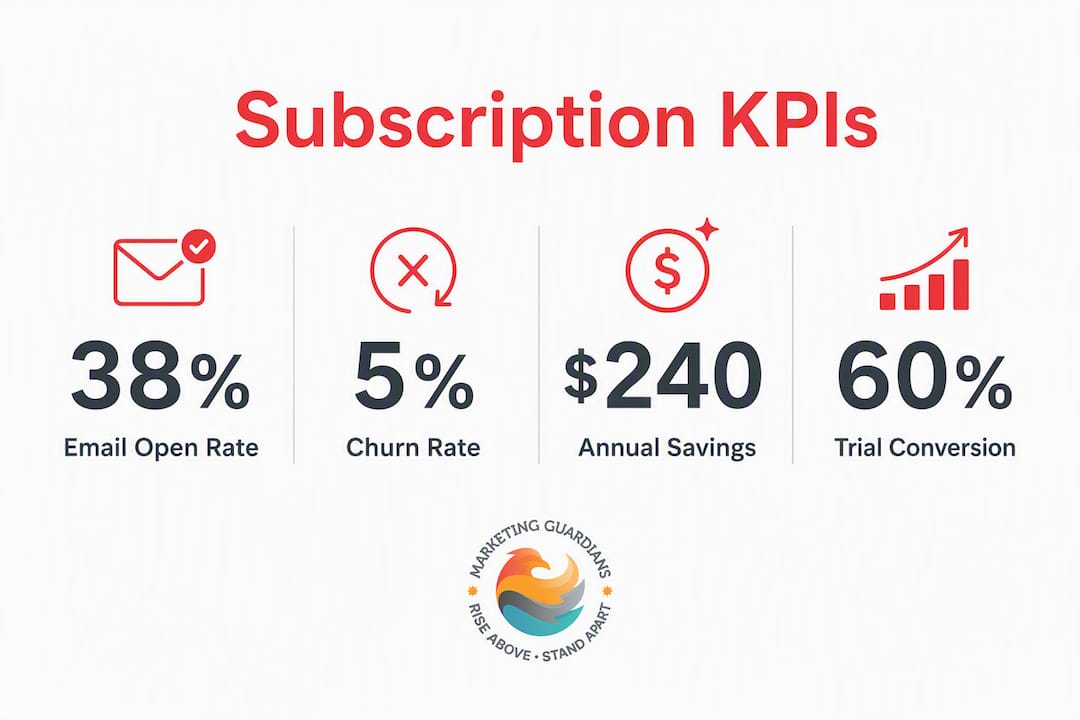
One practical note on measurement: cohort analysis almost always reveals more than a snapshot. A monthly churn rate of 5% looks the same whether it is driven by new subscribers cancelling in month two or long-tenured subscribers leaving after 18 months — but the interventions are completely different. Build cohort views into your reporting from day one, and you’ll catch the real pattern faster.
Which acquisition channels work best for subscription businesses?
The single most efficient acquisition strategy depends on your model: free trials for SaaS, a first-order convenience discount for replenishment, and VIP access or early-feature perks for membership and services. The channel mix that delivers those offers varies, but the following sequence reflects where most Canadian subscription businesses find the best CAC-to-LTV ratio.
- SEO and content marketing: Organic search builds compounding acquisition at a lower marginal CAC than paid channels over time. For services subscriptions, long-form guides, comparison pages, and case studies attract buyers who are already evaluating options — the highest-intent traffic you can earn without paying per click.
- Paid search and social: Google Ads and Meta campaigns are the fastest way to test offer structures and messaging. Run paid search against high-intent queries (“subscription marketing agency Canada”) and use social to build awareness and retarget trial abandoners. PPC management works best when campaigns are structured around subscriber intent, not just clicks.
- Referral programmes: Existing subscribers who refer a peer convert at a higher rate and churn at a lower rate than cold-acquired subscribers. A well-structured referral incentive — credit toward the next billing cycle, an upgrade, or a cash reward — is one of the highest-ROI acquisition levers available, particularly for services subscriptions where trust is the primary purchase driver.
- Content partnerships and co-marketing: Partnering with complementary businesses (an accountant partnering with a bookkeeping SaaS, for example) reaches a pre-qualified audience at shared cost. For Canadian B2B services, industry associations and chamber partnerships can open referral pipelines that paid ads cannot replicate.
- Influencer and creator content: Most effective for curated box and consumer subscriptions, where unboxing and review content drives discovery. For B2B services, thought-leadership collaborations with respected practitioners carry more weight than traditional influencer formats.
- Events and webinars: Live formats build trust faster than any written content. A free webinar that delivers genuine value positions the host as the obvious next step for attendees who want ongoing support.
Offer structures that convert
Research on subscription acquisition tactics consistently highlights free trials, limited-time discounts, referral rewards, and bundled services as the primary conversion drivers. A few practical rules:
- Trial length: 7-day trials work for simple SaaS; 14–30 days are more appropriate for services where value takes time to demonstrate. Shorter trials create urgency; longer trials increase the quality of the conversion.
- Freemium vs. trial: Freemium keeps users in the product indefinitely but delays revenue and can reduce urgency to upgrade. A time-limited trial with a clear expiry creates a natural conversion moment.
- Discounting: First-month discounts attract price-sensitive subscribers who churn faster. Annual prepay discounts attract committed subscribers who churn slower. When you discount, discount the commitment, not the value.
- Referral incentives: Two-sided rewards (both referrer and referee receive value) outperform one-sided programmes in activation rate.
Pro Tip: Track trial quality, not just trial volume. A high trial sign-up rate paired with a low trial-to-paid conversion rate signals an offer or onboarding problem, not an acquisition success. Monitor the ratio weekly and treat a conversion rate below your baseline as a higher-priority alert than a dip in raw sign-up numbers.
How should you structure pricing and packaging to improve conversion?
Pricing is both a revenue lever and a retention lever. The mistake most subscription businesses make is treating it as a one-time decision rather than an ongoing test. Pick testable levers and run them systematically — you don’t need to redesign your entire pricing architecture to move conversion meaningfully.
A practical packaging checklist for Canadian subscription businesses:
- Clear value steps between tiers: Each tier should offer a benefit the tier below cannot access, not just a higher usage limit. Subscribers who can articulate why they’re on a given tier churn less.
- Billing cadence effects: Monthly billing lowers the commitment barrier at acquisition but produces higher churn. Annual billing reduces churn and improves cash flow. Offer both, and use a modest annual discount (typically 15–20%) to shift subscribers toward the stickier option.
- Cancellation transparency: Hiding the cancel button increases short-term revenue and long-term resentment. A transparent, low-friction cancellation flow with a well-designed save offer (a pause option, a downgrade, a one-month credit) retains more subscribers than a dark pattern ever will.
- Add-ons and expansion revenue: Modular add-ons let subscribers grow their spend without requiring a full tier upgrade. For services subscriptions, this might mean adding a reporting dashboard, an extra channel, or a dedicated account manager.
A/B test ideas you can run now
Test pricing copy before you test prices. “Save $240 annually” often outperforms “Get two months free” even when the value is identical — the framing changes the perceived gain. For trial-to-paid nudges, test the timing of the upgrade prompt (day 5 vs. day 12 of a 14-day trial) before testing the offer itself. On discount expiry, a countdown timer in the final 48 hours of a promotional window consistently lifts conversion without requiring a deeper discount.
For Canadian customers specifically, displaying prices in CAD and being explicit about GST/HST treatment at checkout reduces cart abandonment. Billing transparency is also a compliance consideration: Canada’s consumer protection framework expects clear disclosure of recurring charges, billing dates, and cancellation terms before the subscriber commits.
How do you design onboarding that keeps subscribers past the first 90 days?
The first 30–90 days determine long-term retention. Research on subscription onboarding confirms that structured onboarding focused on time-to-value — getting the subscriber to a clear, tangible win early — increases retention materially. The “aha moment” is not a nice metaphor; it is the specific point at which a subscriber’s perceived value exceeds their perceived cost, and everything before that moment is a retention risk.
Onboarding flow checklist
- Day 1: Welcome communication that sets expectations (what happens next, who their contact is, what success looks like in 30 days).
- Days 2–7: First usage or engagement milestone. For a SaaS product, this might be completing a core workflow. For a services subscription, it might be the first strategy call or the delivery of an initial audit.
- Days 8–21: Product education or service education touchpoints. These should be triggered by behaviour, not just calendar timing — a subscriber who has already completed the milestone does not need the tutorial.
- Days 22–30: First check-in. A brief survey or a scheduled call that confirms the subscriber is on track and surfaces any early dissatisfaction before it becomes a cancellation decision.
- Days 31–90: Milestone reward or recognition. Acknowledge the subscriber’s progress and introduce the next value layer — an advanced feature, an expanded service, or a community resource.
Sample email sequence themes
A five-message onboarding sequence covers: (1) a warm welcome with a single clear next action, (2) a value-set email that reminds the subscriber why they signed up and what they’ll achieve, (3) a milestone email triggered when they complete a key action, (4) a check-in email that invites a reply or a call, and (5) an activation nudge for subscribers who have not yet reached the first milestone.

Onboarding should be owned jointly by marketing (the automated sequence) and customer success (the high-touch check-ins). The data points to track are time-to-first-milestone, email open and click rates within the sequence, and 30-day and 90-day retention rates by cohort.
How do you stop churn before subscribers decide to cancel?
Retention is a marketing problem that must be automated where possible and escalated to high-touch when the signals warrant it. Waiting for a subscriber to hit the cancel button is too late; the goal is to detect leading indicators and intervene before the decision is made.
Retention marketing across the full subscriber lifecycle — onboarding, engagement, re-engagement, and win-back — delivers outsized ROI compared with pure acquisition spend, and dedicating 30–40% of your marketing budget to retention is a reasonable target depending on your current churn rate.
- Declining engagement flow: When a subscriber’s login frequency, feature usage, or content consumption drops below a defined threshold, trigger a re-engagement sequence. The first message should acknowledge the gap and offer a specific reason to return (a new feature, a results summary, a helpful resource).
- Cancellation save flow: When a subscriber initiates cancellation, present a structured save offer before confirming. Options include a pause (30 or 60 days), a downgrade to a lower tier, or a one-month credit. The save offer should be personalised to the subscriber’s usage pattern where possible.
- Milestone reward flow: Recognise subscribers at tenure milestones (3 months, 6 months, 1 year). A brief acknowledgement with a small reward or an exclusive benefit reinforces the relationship and signals that the business values long-term subscribers differently from new ones.
- Win-back sequence: For subscribers who have already cancelled, a three-to-four message win-back sequence sent over 30–60 days can recover a meaningful portion. The most effective win-back messages lead with what has changed since the subscriber left, not with a discount.
Leading indicators to monitor
Watch for: declining login or usage frequency, a rise in support tickets (especially billing or value-related complaints), missed or failed payments, and a drop in engagement with lifecycle emails. Each of these should have a defined trigger response — not a manual review process, but an automated intervention that fires within 24–48 hours of the signal.
Pro Tip: Blend Customer Success and marketing-owned retention campaigns deliberately. Marketing owns the automated sequences and the data triggers; Customer Success owns the high-touch calls and the quarterly business reviews. Structured client reviews — QBRs, value reviews, and executive alignment sessions — are among the highest-leverage retention practices for services subscriptions, and they scale best when marketing automation handles the lower-touch touchpoints so Customer Success can focus on the accounts most at risk.
What do Canadian benchmarks tell us about subscription marketing performance?
The most useful Canadian benchmark for lifecycle and retention campaigns is email performance. CyberImpact’s 2026 State of Email Marketing in Canada provides the clearest set of Canada-specific targets available, covering average open rates, click-through rates, unsubscribe rates, and typical send frequency by organisation type. These figures give you a direct comparison point for your own onboarding and retention sequences.
| Metric | Canadian benchmark (2026) | What it signals for subscriptions |
|---|---|---|
| Email open rate | 38% | Measures subject line relevance and list health |
| Click-through rate (CTR) | 4.5% | Measures content relevance and CTA clarity |
| Unsubscribe rate | 0.2% | Early warning for list fatigue or poor segmentation |
| Emails sent per month | 5 | Frequency benchmark for lifecycle planning |
For email frequency specifically, a useful complement is the email marketing essentials guide from Solution for Guru, which covers cadence planning and list segmentation practices relevant to Canadian lifecycle campaigns.
Beyond email, the Eightx Canada ecommerce KPI benchmark report provides CAC and conversion benchmarks by vertical for Canadian businesses, which are useful reference points when evaluating whether your acquisition spend is in range for your category.
Canadian subscription businesses that audit their service stack annually and maintain a continuity plan for provider changes are significantly better positioned to sustain subscriber trust through market disruptions. As NetNewsLedger’s 2026 analysis of B2B subscription models notes, the shift to subscription delivery across industries has made annual audits and continuity planning standard practice for serious operators.
A short Canadian case study
Marketing Guardians worked with a Canadian professional services client that was experiencing high trial-to-paid drop-off and inconsistent month-two retention. The team restructured the onboarding sequence to deliver a clear first-milestone moment within seven days, added a 30-day check-in call to the Customer Success workflow, and introduced a declining-engagement email trigger for subscribers who had not logged in within 14 days. You can review the documented results on the Marketing Guardians site, including the before-and-after metrics and the timeline of the test.
For Canadian B2B subscription services specifically, an annual audit of your subscription stack — reviewing which tools, vendors, and service providers you depend on — is a practical safeguard. Provider consolidation, pricing changes, or service discontinuation can disrupt your delivery model without warning, and a continuity plan reduces that exposure.
How do you implement this plan with the right team and tools?
Start with three tool categories: payment and subscription management, behavioural analytics, and lifecycle automation. Everything else can be added once those three are producing clean data and reliable workflows.
Team responsibilities:
- Marketing owns acquisition campaigns, lifecycle email sequences, and the automated retention flows. Marketing also owns the measurement framework and the reporting cadence.
- Customer Success owns high-touch onboarding calls, quarterly business reviews, and escalated save conversations. For smaller teams, one person may carry both roles, but the responsibilities should be tracked separately.
- RevOps (or the business owner in smaller organisations) coordinates the data flows between tools, owns the subscriber data model, and manages the integration between payment, CRM, and analytics systems.
Implementation checklist
- Map your subscriber data flows before selecting tools. Know where subscriber events (sign-up, first login, upgrade, cancellation) are captured and how they reach your marketing automation platform.
- Build your CASL consent framework before launching any email campaign. Canada’s Anti-Spam Legislation requires express or implied consent for commercial electronic messages, and your sign-up flow must capture and store consent records. This is not optional and applies to every Canadian subscriber on your list.
- Define your event tagging plan. Every meaningful subscriber action should fire a named event that your analytics and automation tools can use as a trigger.
- Select vendors based on four criteria: integration with your existing stack, local billing and tax support (CAD pricing, GST/HST handling), data residency options for Canadian subscribers, and first-party data compatibility as third-party cookies continue to deprecate.
For a deeper look at what to expect from a subscription-based marketing service in terms of delivery structure and reporting, Marketing Guardians publishes a detailed breakdown of how subscription agency models are structured for Canadian clients.
What are the most common pitfalls in subscription marketing and how do you avoid them?
The single most common cause of churn in services subscriptions is value drift: the subscriber’s perception of value declines over time because the service has not evolved to meet their changing needs, or because the results have not been communicated clearly enough to justify the recurring cost. Fixing value drift requires proactive communication, not reactive discounting.
Pricing complexity: Subscribers who cannot quickly explain what tier they’re on or what they’re paying for are at elevated churn risk. Simplify your tier structure to three options or fewer, and make the value difference between tiers concrete and visible.
Inactive subscribers: A subscriber who is not engaging is not a retained subscriber — they are a cancellation waiting for a trigger. Inactive subscribers should enter a re-engagement flow within 14–21 days of their last meaningful action, not at renewal time.
Billing failures: Failed payments are a leading cause of involuntary churn. Implement a dunning sequence (automated payment retry with subscriber notifications) that begins 3–5 days before a payment fails and continues for 7–10 days after. Recovering a failed payment is far cheaper than re-acquiring a lost subscriber.
Poor measurement: Teams that track only MRR and total churn are missing the diagnostic layer. Without cohort analysis and leading indicators, you cannot distinguish between a new-subscriber retention problem and a long-tenured subscriber satisfaction problem — and the interventions are completely different.
Compliance note: Under CASL, all commercial electronic messages to Canadian subscribers require valid consent, a clear sender identification, and a functioning unsubscribe mechanism. Billing transparency obligations under Canadian consumer protection law also require that recurring charges, billing dates, and cancellation terms be disclosed clearly before the subscriber commits. Build both into your sign-up flow from the start.
Key takeaways
Subscription marketing succeeds when acquisition, onboarding, and automated retention operate as a single coordinated system rather than three separate campaigns.
| Point | Details |
|---|---|
| Prioritise retention spend | Dedicating 30–40% of your marketing budget to retention delivers outsized ROI compared with pure acquisition spend. |
| Onboard within 30–90 days | The first 30–90 days are the critical retention window; structured onboarding focused on time-to-value increases long-term subscriber retention materially. |
| Track cohorts, not snapshots | Cohort analysis reveals whether churn is a new-subscriber or long-tenured problem, which determines the right intervention. |
| Use Canadian email benchmarks | Use 2026 Canadian benchmarks for email open rate (38%), CTR (4.5%), and unsubscribe rate (0.2%) as your core comparison points for lifecycle and retention campaigns. |
| Marketing Guardians as your partner | Marketing Guardians delivers subscription-based SEO, PPC, social media management, and analytics for Canadian businesses seeking measurable, ongoing growth. |
Why the conventional wisdom on subscription marketing gets retention backwards
Most subscription marketing advice treats acquisition as the hard problem and retention as the maintenance task. We’d argue that framing is exactly backwards — and it costs businesses real revenue.
Acquisition is a solved problem in the sense that you can always spend more to get more subscribers. The ceiling on acquisition is budget. The ceiling on retention is the quality of the value you deliver and how well you communicate it. That second ceiling is much harder to raise, which is why businesses that invest in retention infrastructure early compound their growth faster than those that keep pouring budget into the top of the funnel.
There’s another nuance that rarely gets discussed: the relationship between pricing transparency and retention. Subscription businesses that are fully transparent about what subscribers are paying for, what they’re getting, and how to cancel retain subscribers longer than those that obscure any of those elements. The counterintuitive truth is that making it easy to leave makes subscribers more likely to stay, because it signals confidence in the value being delivered.
For Canadian B2B services specifically, the quarterly business review is probably the single most underused retention tool available. A structured QBR that reviews results, surfaces the subscriber’s evolving goals, and maps the next 90 days of work does more for retention than any automated email sequence. Automation handles the volume; the QBR handles the relationship. Both are necessary, and neither replaces the other.
How Marketing Guardians helps subscription businesses grow
Growing a subscription business in Canada means staying visible at the acquisition stage, converting trials efficiently, and keeping subscribers engaged long enough to generate real LTV. Marketing Guardians delivers exactly that through subscription-based SEO, PPC advertising, and social media management — all structured as ongoing monthly plans with no long-term contracts.
Unlike hiring an in-house team or engaging a traditional agency on a project basis, a Marketing Guardians subscription gives you a dedicated team across SEO, paid search, content, and analytics, reporting against the KPIs that actually matter for recurring revenue growth. Every plan is built around your specific model and goals, not a generic channel checklist. If you want to see what that looks like in practice, book a discovery call with the Marketing Guardians team and we’ll map out a subscription marketing plan tailored to your business.
Useful sources
A short list of vetted, Canada-relevant resources to support your implementation:
- State of Email Marketing in Canada 2026 — CyberImpact: The most current Canada-specific email benchmark report available, covering open rates, CTR, unsubscribe rates, and send frequency. Use it to set realistic targets for your onboarding and retention sequences.
- Canada ecommerce KPI benchmark 2026 — Eightx: Provides CAC, conversion rate, and AOV benchmarks by vertical for Canadian businesses. Useful for validating whether your acquisition economics are in range for your category.
- How subscription models are transforming B2B services in 2026 — NetNewsLedger: A practical overview of the B2B subscription shift, with guidance on annual audits and continuity planning for Canadian operators.
- Client retention strategies for agencies and B2B services — Perspective AI: A five-point structured playbook covering QBRs, value reviews, and executive alignment — directly applicable to services subscription retention.
- Retention marketing for subscription businesses — Exacti: Maps retention marketing across the full subscriber lifecycle with budget allocation guidance and onboarding milestone recommendations.
- Measuring digital marketing ROI: a 2026 guide — Solution for Guru: A practical measurement framework for attribution and ROI tracking, useful when building your subscription marketing reporting stack.
- What are marketing subscription services — Marketing Guardians: Marketing Guardians’ own guide to subscription-based marketing services, useful for readers who want a deeper explanation of how agency subscription delivery is structured.
FAQ
What is a marketing subscription service?
A marketing subscription service is an ongoing, recurring arrangement where a business pays a monthly fee for a defined set of marketing activities — such as SEO, PPC, social media management, or content creation — delivered by an agency or platform rather than an in-house team.
How do you market a subscription service effectively?
The most effective approach combines a low-friction acquisition offer (free trial, first-month discount, or referral incentive), a structured onboarding sequence that delivers a clear value milestone within the first 30 days, and automated retention flows triggered by behavioural signals like declining usage or missed logins.
What is the subscription trap and how do you avoid it?
The subscription trap refers to a model where subscribers are locked in through obscured cancellation processes or recurring charges they did not clearly consent to. Canadian businesses avoid it by disclosing billing terms transparently at sign-up, offering easy pause or cancel options, and complying with CASL consent requirements for all commercial electronic messages.
Which KPIs matter most for subscription marketing in Canada?
At the acquisition stage, CAC and trial-to-paid conversion rate are the priority metrics. As the business matures, LTV, Net Revenue Retention, and monthly churn rate become the primary growth indicators to monitor on a cohort basis.
How long does it take to see results from a subscription marketing strategy?
Most subscription businesses see meaningful data on trial-to-paid conversion and 30-day retention within the first 60–90 days of a structured programme. Cohort-level LTV and NRR trends typically require 6–12 months of consistent data to interpret reliably.
Recommended

AI search is changing fast. Download our Playbook to make sure you keep up.
Inside our AI Search and GEO Playbook, you’ll find a readiness checklist and a few copy-and-paste building blocks:
- Add Organization, Person, and Service schema to your About and Services pages.
- Add a short FAQ to your top service page with two or three real customer questions.
Small changes like these help AI systems understand who you are, what you do, and when to reference you.
Where to start if you feel behind? Just begin with one page - one question - one clear answer. Then open the Playbook and pick the next small step. Consistency beats intensity here. Your future self will be glad you started this month.


