Why Does Most Website Traffic Fail to Convert?
Most website traffic fails to convert because of slow load times, poor user experience, and unclear value propositions. Learning to convert website traffic into sales online starts with fixing these core issues.
If you want to convert website traffic into sales online, you need to fix these issues first. The average website conversion rate across all industries is just 2.3%. Meanwhile, top performers in the 90th percentile hit 11% or higher. That gap represents a massive opportunity for businesses ready to convert website traffic into sales online through smart optimization.
So why do visitors bounce? There are several common reasons. First, 63% of visitors leave pages that take more than four seconds to load. Second, 90% abandon sites with poor user experience. Third, unclear value propositions fail to answer the question every visitor asks: "What is in it for me?" For ecommerce specifically, the average conversion rate sits at 2.9%, while high performers reach 5% to 7%. As a result, even small improvements in converting website visitors to sales can deliver significant revenue gains.
How to Convert Website Visitors Into Customers
Effective strategies to convert web traffic into sales start with the basics. Clear calls to action, simplified navigation, and trust signals form the foundation. In fact, a single CTA button can achieve a 13.5% conversion rate. Additionally, simplified navigation can increase conversions by up to 100% by removing distractions that pull visitors away from the action you want them to take.
Benefit-driven CTA buttons outperform generic ones by 19%. Instead of "Submit" or "Click Here," use language like "Get My Free Guide" or "Start Saving Today." Furthermore, intuitive UX design can increase conversion rates by up to 200%. These are not minor tweaks; they are foundational changes that directly impact how to convert website visitors into customers.
Optimize Your Landing Pages
Your landing pages are where conversions happen or fall apart. Consequently, every element matters. Headlines should be clear and benefit-focused. Forms should ask for no more than three fields. Multi-step forms outperform single-page forms because they reduce the mental load at each step.
Moreover, mobile optimization is essential. Websites optimized for mobile show 23% higher conversion rates and 67% lower bounce rates. With mobile devices driving roughly two-thirds of all web traffic, a poor mobile experience means losing the majority of your audience. Marketing Guardians specializes in landing page development that puts conversion at the center of every design decision.
Use Data to Understand Visitor Behavior
You cannot improve what you do not measure. Therefore, analytics tools, heatmaps, and session recordings are essential for converting website visitors to sales. Different traffic sources convert at very different rates:
| Traffic Source | Average Conversion Rate |
|---|---|
| Direct traffic | 3.3% |
| Email marketing | 2.8% |
| Organic search (SEO) | 2.3% |
| Organic social | 1.8% |
| Paid social | 1.6% |
| Search engine marketing | 1.5% |
In addition, organizations that run monthly conversion rate optimization (CRO) experiments see a 1.8x increase in annual revenue. However, 43% of A/B tests fail because of inadequate sample sizes. According to Google Analytics best practices, consistent testing with proper methodology matters more than running occasional experiments. A professional analytics and reporting setup helps you track what works and what needs fixing.
Build Trust to Drive Conversions
Trust is the invisible barrier between a visitor and a sale. Without it, even the best offer will not convert. Products with customer reviews have a 270% higher purchase likelihood compared to those without. Similarly, security badges increase conversions by 7% to 12%, and 18% of users abandon forms specifically because of security concerns.
Video testimonials are especially powerful. They increase conversion rates by 80% compared to text reviews. In addition, 75% of website credibility comes from design quality. A dated, cluttered site tells visitors that a business is not trustworthy. Conversely, a clean, professional design signals competence and reliability.
| Trust Signal | Conversion Impact |
|---|---|
| Customer reviews | 270% higher purchase likelihood |
| Video testimonials | 80% conversion rate improvement |
| Security badges | 7-12% increase |
| Professional design | 75% of credibility perception |
Email and Retargeting Strategies That Bring Visitors Back
Not every visitor will convert on the first visit. That is why retargeting and email marketing are essential for businesses that want to convert website traffic into sales online. Email marketing delivers an average return of $36 for every $1 spent. Top performers see $68 per dollar. These numbers make email one of the highest-ROI channels available.
Furthermore, abandoned cart emails recover 10% to 15% of lost purchases. The best campaigns hit 23% recovery rates. Personalized emails achieve 26% higher open rates and 18% better conversion rates than generic messages. For optimal results, research suggests sending 5 to 8 emails per month.
Consider this: the average cart abandonment rate is 70.22%. That represents approximately $260 billion in recoverable revenue globally. Consequently, even a modest improvement in cart recovery directly impacts the bottom line. Smart email automation, combined with conversion optimization services, helps businesses capture revenue they would otherwise lose.
Measuring and Improving Your Conversion Rate
Ongoing measurement separates businesses that grow from those that plateau. Track these key metrics: conversion rate, cost per acquisition (CPA), and customer lifetime value (CLV). Together, they reveal whether your effective strategies to convert web traffic into sales are working.
Urgency messaging can increase conversions by nearly 3x, jumping from 3.5% to 10%. Exit-intent popups convert at 3% to 5% and reduce cart abandonment by 20%. Additionally, adding video to landing pages boosts conversion by up to 80%. Pages with video convert 34% higher on average than those without.
As a result, the path to better conversions is not a single fix. It is a system of continuous testing, data analysis, and iterative improvement. Businesses that convert website traffic into sales online treat optimization as an ongoing process, not a one-time project. Businesses that commit to monthly CRO experiments consistently outperform those that make changes based on guesswork. The data is clear: systematic optimization is how to convert website visitors into customers at rates that drive real growth. Every business that wants to convert website traffic into sales online should start with a baseline measurement, then test one change at a time.
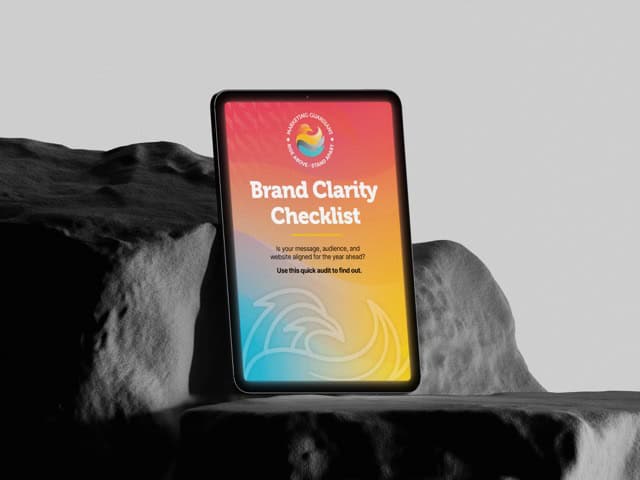
Get Your Free Brand Clarity Checklist
The Brand Clarity Checklist is a quick audit you can run in about 10 minutes to see if your message, audience, and website are actually aligned, or if they are quietly working against each other.
What you will be auditing inside the checklist:
- Your Ideal Customer
- Your Core Messaging
- Your Website Homepage
- Strategic Alignment
If your score shows “close, but not quite,” you are in good company. Most teams do not have a marketing problem. They have a clarity problem that creates mixed signals, inconsistent leads, and wasted effort.