Start by writing a focused 12-month marketing plan and prioritising the low-cost channels where your customers already search. For most Alberta small businesses, that means a functional website with clear decision pages, a claimed and optimised Google Business Profile, and a CASL-compliant email list built on express consent. Everything else — social media, paid search, partnerships — layers on top once those foundations are generating measurable leads.
Statistics Canada frames a written marketing plan as the cost-effective way to identify your ideal customer and convert promotional activity into actual sales. BDC reinforces this: a plan covering the next 12 months, with clear goals, assigned accountabilities, and tracked conversions, is what separates businesses that grow from those that plateau. CASL and the CRTC govern every commercial email you send in Canada, and the compliance burden sits entirely with you as the sender. Marketing Guardians works with Alberta small businesses to build and execute exactly this kind of plan when owners want recurring support without the overhead of a full-time hire.
Quick monthly budget tiers to start:
- Micro business (under $250K revenue): $300–$600/month. Spend on Google Business Profile optimisation, one social channel, and a basic email tool.
- Small business ($250K–$1M revenue): $800–$2,000/month. Add local SEO, a simple content calendar, and a modest Google Ads test.
- Growing SMB ($1M–$3M revenue): $2,500–$5,000/month. Scale paid search, invest in content, and bring in professional measurement.
30/60/90-day first moves:
- Day 1–30: Write your one-page marketing plan, claim your Google Business Profile, and set up a CASL-compliant email signup on your website.
- Day 31–60: Publish three to five website pages that answer your buyers’ most common questions. Launch one email sequence to new subscribers.
- Day 61–90: Run a 30-day paid search or organic social experiment with a defined budget and a clear decision rule (continue or cut based on cost per lead).
Pro Tip: Don’t try to be everywhere at once. Pick the single channel where your ideal customer is most likely to discover you, run a 30-day experiment there, and measure cost per lead before adding a second channel.
Table of Contents
- What should your 12-month marketing plan actually include?
- Which low-cost tactics actually work for Canadian small businesses?
- How do you set a realistic small-business marketing budget?
- What are the three KPIs every small business should track?
- What do you need to know about CASL before you email customers?
- What free and low-cost tools can Canadian small businesses use right now?
- Three sample 12-month marketing plans with budgets
- Key takeaways
- What we see working now for Canadian small businesses
- Marketing Guardians: subscription-based digital marketing for Alberta small businesses
- Authoritative Canadian sources and downloadable templates
- FAQ
What should your 12-month marketing plan actually include?
BDC recommends treating a marketing plan as a how-to document for hitting your targets, not a strategy deck that lives in a drawer. The plan should be short enough to act on and specific enough to measure. Here is the template structure we recommend for Alberta small businesses.
Core template fields
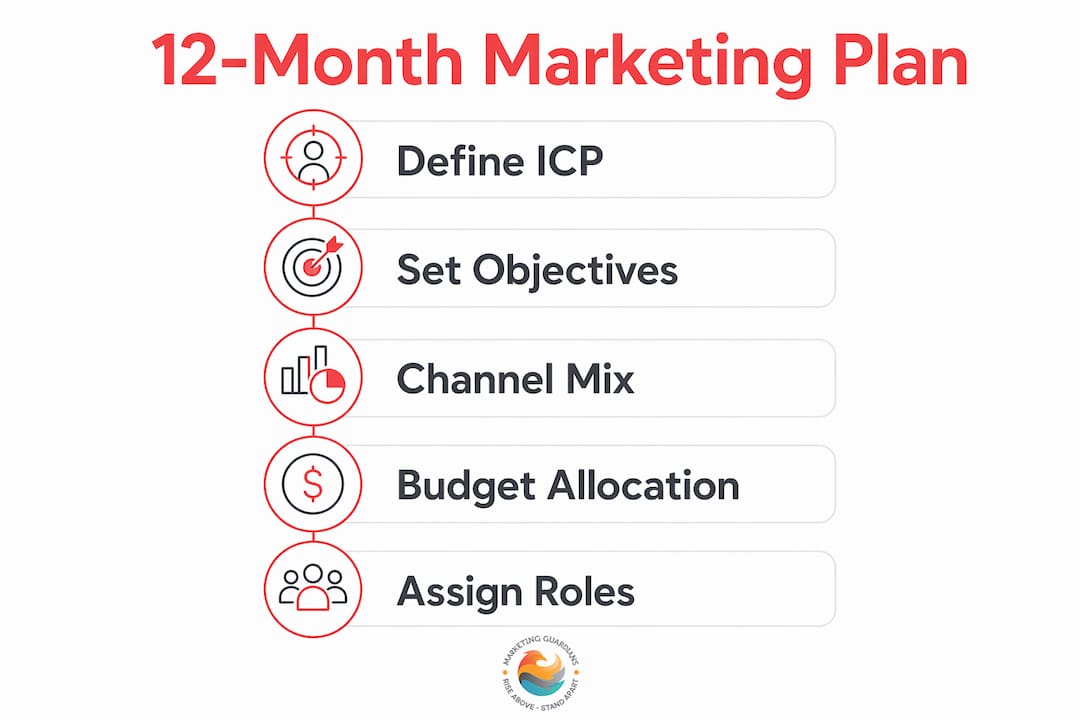
Mission and positioning: One or two sentences describing what you do, who you serve, and what makes you the better choice. This becomes the anchor for every piece of messaging you write.
Ideal customer profile (ICP): Name the single segment you are targeting first. Include demographics, buying behaviour, where they search for solutions, and what objections they raise before purchasing. Trying to serve everyone in year one is the fastest way to waste a small budget.

Primary marketing objective: One measurable goal for the year. Examples: generate 20 qualified leads per month by December, grow email list to 500 subscribers, or achieve 50 Google reviews with an average rating above 4.5. BDC advises setting both financial and non-financial objectives so you can track progress before revenue moves.
Leading indicators and revenue goal: Identify the two or three metrics that predict revenue — website visits, lead form submissions, email open rates — and set monthly targets for each. These are your early-warning system.
Channel mix and estimated spend by media type: FedDev Ontario’s marketing plan outline makes this explicit: list each channel, its estimated monthly spend, and the time your team will spend on it. This single discipline prevents the channel overload that kills most small-business marketing efforts.
Responsibilities: Name who owns each channel. For solo owners, this is you. For small teams, assign one person per channel so nothing falls through the cracks.
Breaking the year into quarters
Quarters give you natural review points without forcing weekly strategy sessions. A practical rhythm looks like this:
- Q1 (January–March): Foundation. Website decision pages live, Google Business Profile optimised, email consent capture active, one channel experiment running.
- Q2 (April–June): Build. Analyse Q1 experiment results, scale what worked, cut what didn’t, add one new tactic.
- Q3 (July–September): Seasonal push. Most Alberta service businesses see demand peaks in late summer; retail peaks in November–December. Front-load content and paid spend four to six weeks before your peak.
- Q4 (October–December): Scale and plan. Increase budget on proven channels, run your annual review, and write next year’s plan before December 31.
The 30/90-day experiment template
Every channel experiment should answer one clear question before you commit more budget. Use this structure:
- Hypothesis: “If we run Google Ads targeting [keyword] in Calgary/Edmonton for 30 days at $20/day, we will generate at least 10 qualified leads at a cost per lead under $60.”
- Target metric: Cost per lead (CPL) or cost per acquisition (CPA).
- Budget: Fixed amount for the test period. Do not increase mid-experiment.
- Test steps: Set up tracking, launch, monitor weekly, do not optimise until day 21.
- Decision rule: If CPL is under your target by day 30, double the budget. If it is over by more than 50%, pause and test a different channel or message.
Role map for small teams
| Team size | Who owns strategy | Who executes | Who measures |
|---|---|---|---|
| Solo owner | You | You (or freelancer) | You (monthly review) |
| 2–4 employees | Owner | One designated team member | Owner reviews monthly |
| 5+ employees | Owner or ops lead | Marketing hire or agency | Shared dashboard, monthly |
Which low-cost tactics actually work for Canadian small businesses?
BDC’s 2026 channel research surfaces a striking gap: over half of businesses use online search to find suppliers, yet only about one in five advertise there. That mismatch is your opportunity. The tactics below are ordered by the likelihood that your buyer will encounter them during their decision process, not by what is trendy.
Website decision pages
Your website is not a brochure. It is the place where a buyer decides whether to contact you or leave. Every service or product page should answer four questions: What is it? Who is it for? Why should I trust you? What do I do next? Pages structured this way also perform better in AI-assisted search results, where local businesses can win in AI-driven search by providing clear, structured answers to specific buyer questions.
Google Business Profile
Claim it, verify it, and update it weekly. Add photos, respond to every review (positive and negative), post a monthly update, and fill in every attribute field. For local service businesses in Alberta, a well-maintained Google Business Profile often generates more inbound leads than a paid campaign at a fraction of the cost.
Organic social storytelling
Choose one platform based on where your buyers spend time: Instagram and Facebook for consumer-facing businesses, LinkedIn for B2B. Post three times per week: one educational post, one behind-the-scenes post, and one social proof post (a review, a completed project, a client result). Batch-produce content in two-hour blocks once a week rather than scrambling daily. A social media strategy built for small teams follows this exact rhythm and keeps output consistent without burning out the owner.

Email marketing
Email consistently delivers one of the highest returns of any digital channel for small businesses. Build your list through a lead magnet (a checklist, a guide, a free consultation offer) on your website. Send a welcome sequence of three emails over two weeks, then a monthly newsletter. Keep it short: 200–300 words, one clear call to action. Every email must comply with CASL (see the legal section below).
Local partnerships and referrals
Identify three to five complementary businesses in your area that serve the same customer without competing with you. A bookkeeper partnering with a business lawyer, or a physiotherapist partnering with a personal trainer, are classic examples. Formalise the referral arrangement: agree on how you will introduce each other, whether that is a co-hosted event, a shared email, or a simple verbal referral. Referrals close at a significantly higher rate than cold leads because trust transfers.
Low-budget PPC
Google Ads and Meta Ads both allow you to start with as little as $10–$15 per day. The key is narrow targeting: one campaign, one ad group, three to five keywords, one landing page. Measure cost per lead weekly. Online advertising platforms for small businesses break down platform selection and budget management in detail if you are deciding where to start.
Content that answers buyer questions
Write or record answers to the five questions your customers ask most often before they buy. These become blog posts, FAQ pages, or short videos. They serve three purposes simultaneously: they build trust with buyers, they improve your organic search rankings, and they give AI search engines structured content to cite when someone asks a related question.
Pro Tip: Reuse every piece of content across at least three formats. A blog post becomes a social caption, an email section, and a short video script. One hour of content creation should produce a week’s worth of posts.
Channel selection by business type:
- Local service business (plumber, accountant, physiotherapist): Google Business Profile first, then website decision pages, then email, then referral partnerships.
- Physical retail: Google Business Profile, Instagram/Facebook storytelling, seasonal email promotions, local event sponsorships.
- E-commerce: Website conversion optimisation first, then Google Shopping or Meta Ads, then email sequences for cart abandonment and repeat purchase.
How do you set a realistic small-business marketing budget?
There is no single correct percentage, but there are defensible starting points. Local businesses typically allocate 5–10% of revenue to digital marketing, with higher allocations justified during growth phases or when launching a new product. The three approaches below give you a framework to choose from based on your situation.
Three budget-sizing approaches
Percentage of revenue: Take 5–10% of your projected annual revenue and divide it by 12 for a monthly figure. This is the most common approach and the easiest to defend to a bookkeeper.
Goal-backed budgeting: Work backwards from your revenue target. If you need 10 new clients per month, your average client is worth $500, and your historical close rate from leads is 20%, you need 50 leads per month. If your cost per lead from Google Ads is $40, your minimum viable ad spend is $2,000/month. Add 20–30% for tools, content, and management.
Minimum viable spend: The floor below which most channels do not generate enough data to optimise. For Google Ads, that is roughly $600–$800/month in most Alberta markets. For organic social and email, the floor is time, not money.
Sample budget allocations by revenue band
| Revenue band | Monthly budget | Channel split |
|---|---|---|
| Under $250K | $300–$600 | 40% local SEO/GBP, 30% email tools + content, 30% one social channel |
| $250K–$1M | $800–$2,000 | — |
| $1M–$3M | $2,500–$5,000 | 30% paid search, 25% SEO/content, 20% social, 15% email, 10% partnerships/events |
Front-loading experiments: a 12-month timeline
| Period | Focus | Budget allocation |
|---|---|---|
| Months 1–3 | Foundation + first experiment | 60% on one channel, 40% on tools and setup |
| Months 4–6 | Scale winner, test second channel | 50% on proven channel, 30% on new test, 20% tools |
| Q3 (July–September) | Seasonal push | Increase proven channels by 20–30% ahead of peak |
| Months 10–12 | Scale and plan | Maintain proven channels, reduce experiments, plan next year |
The FedDev Ontario marketing plan outline recommends breaking your budget into estimated spend by media type and time spent — two columns that force you to be honest about what is actually executable with your team’s capacity.
What are the three KPIs every small business should track?
BDC frames marketing planning as a measurement problem as much as a creativity problem. Without clear metrics, you cannot tell whether a channel is working or whether you are simply spending money. Keep your dashboard to three primary KPIs and review them on a defined cadence.
KPI 1: Cost per lead (CPL) or cost per acquisition (CPA)
CPL measures how much you spend to generate one qualified enquiry. CPA measures how much you spend to close one paying customer. For most small businesses, CPL is the more actionable number because it tells you whether a channel is worth scaling before you wait for the full sales cycle to close. Calculate it monthly per channel: total channel spend divided by leads generated from that channel.
KPI 2: Lead-to-customer conversion rate
This is the percentage of leads that become paying customers. If you generate 50 leads and close 10, your conversion rate is 20%. A low conversion rate usually signals a messaging or follow-up problem, not a channel problem. Track this monthly and compare it across lead sources — referral leads typically convert at a higher rate than cold paid-search leads.
KPI 3: Customer lifetime value (LTV) or first-order revenue
For subscription or repeat-purchase businesses, LTV is the total revenue a customer generates over their relationship with you. For single-transaction businesses, first-order revenue is the simpler proxy. LTV tells you how much you can afford to spend acquiring a customer. If your LTV is $1,200 and your CPA is $80, you have a healthy margin to scale. If your CPA is $400, you need to either reduce acquisition costs or increase LTV through upsells and retention.
Tracking cadence and tools
| Metric | Review frequency | Tool |
|---|---|---|
| Website traffic and lead form submissions | Weekly | Google Analytics 4 |
| Google Business Profile views and calls | Weekly | GBP Insights dashboard |
| Email open rate and click rate | Per send | Mailchimp, Klaviyo, or similar |
| CPL per channel | Monthly | Spreadsheet or simple CRM |
| Lead-to-customer conversion rate | Monthly | CRM or sales tracking sheet |
| LTV / first-order revenue | Quarterly | Accounting software + CRM |
For small teams running channel experiments, the most important digital marketing metrics to monitor are the ones tied to decisions: CPL tells you whether to continue a campaign, conversion rate tells you whether your offer is landing, and LTV tells you whether the whole system is profitable. Vanity metrics — impressions, follower counts, page views without context — are worth noting but should never drive budget decisions.
Small-sample caution: A 30-day experiment on a $15/day budget will not generate statistically conclusive data. That is fine. The goal is directional signal: is CPL trending toward your target, or is it three times your target with no sign of improvement? Use that signal to make a go/no-go call, not to declare a channel permanently broken or permanently proven.
What do you need to know about CASL before you email customers?
Canada’s Anti-Spam Legislation (CASL) applies to every commercial electronic message (CEM) you send to a Canadian electronic address — email, SMS, and some social messaging. CASL requires three things before you send: consent, identification, and an unsubscribe mechanism. The compliance burden sits entirely with you as the sender.
The three CASL requirements
- Consent: You must have either express consent (the recipient explicitly opted in) or implied consent (a recent business relationship exists). Express consent is always safer because it does not expire under a fixed timeline.
- Identification: Every CEM must identify your business name, your mailing address or website, and a phone number or email address where you can be reached. This contact information must remain valid for at least 60 days after the message is sent.
- Unsubscribe mechanism: Every message must include a clear, functioning way for the recipient to opt out. You must honour unsubscribe requests within 10 business days.
Implied consent: the expiry problem
Implied consent under CASL is available only under specific conditions — typically an existing business relationship — and it expires. An old customer list you have not emailed in two years is almost certainly outside implied consent. Before you send to any cold or dormant list, audit it for consent status. If you cannot prove when and how consent was obtained, do not send.
Operationalising consent in your marketing stack
Log consent type and timestamp in your signup forms, CRM, and email platform. This means recording whether each subscriber gave express or implied consent, the date they consented, and the mechanism (web form, in-person, verbal). Most email platforms (Mailchimp, Klaviyo, HubSpot) have consent fields you can activate. When implied consent expires, your platform should automatically suppress those contacts.
Sample consent text for a website signup form:
Sample unsubscribe footer for emails:
This article provides general information about CASL requirements and is not legal advice. Confirm your specific obligations with the CRTC’s primary resources or a qualified legal professional.
What free and low-cost tools can Canadian small businesses use right now?
The tools below are available in Canada, require no enterprise contract, and cover the core functions a small marketing team needs to execute the plan described in this guide.
Website, SEO, and analytics
Google Analytics 4 (GA4): Free. Tracks website traffic, user behaviour, goal completions, and conversion events. Set up at least two goals: form submissions and phone call clicks.
Google Search Console: Free. Shows which search queries are driving traffic to your site, which pages rank, and where technical issues exist. Check it monthly.
Google Business Profile: Free. The single highest-ROI tool for local businesses. Claim, verify, and update it weekly.
Yoast SEO or Rank Math: Free tiers available for WordPress sites. Guides on-page SEO for each page and post without requiring an SEO specialist.
Email marketing
Mailchimp: Free up to 500 contacts and 1,000 sends per month. Includes CASL-compatible consent fields and unsubscribe management.
Klaviyo: Free up to 250 contacts. Better suited for e-commerce businesses with product catalogues and purchase-triggered automations.
Social media scheduling
Buffer: Free plan allows three social channels and 10 scheduled posts per channel. Enough for a small business running a single-platform strategy.
Meta Business Suite: Free. Manages Facebook and Instagram scheduling, inbox, and basic analytics in one place.
Canadian government and non-profit resources
Statistics Canada Small Business Hub: Provides marketing plan templates, demographic data, and sector-specific research at no cost.
BDC articles and tools: BDC publishes free marketing plan templates, budget worksheets, and channel guides specifically for Canadian SMEs.
Canada Business Network (canada.ca): Lists federal and provincial business support and financing programmes including advisory services and grants for small businesses.
Alberta Innovates and regional chambers of commerce: Offer workshops, mentorship, and sometimes subsidised marketing advisory services for Alberta-based businesses.
When to hire help versus doing it yourself
DIY makes sense when you have time, the channel is low-cost (organic social, email), and you are still in the experiment phase. Bring in a freelancer when you need a specific deliverable: a website redesign, a set of ad creatives, or a content audit. Consider a subscription agency like Marketing Guardians when you need ongoing, multi-channel execution with measurement built in and you want to avoid the overhead of hiring a full-time marketing employee.
Pro Tip: Download BDC’s free marketing plan template and the FedDev Ontario marketing plan outline before you start writing your plan. Both include the “estimated spend by media type” column that forces realistic budget discipline.
Three sample 12-month marketing plans with budgets
The plans below are illustrative frameworks based on typical Alberta small-business scenarios. Adjust channel spend and timelines to your actual revenue, team size, and customer behaviour.
Sample plan 1: Local service business (B2C, e.g., home services, health clinic)
Objective: Generate 15 qualified leads per month by month six, at a CPL under $50.
Channel mix: Google Business Profile (primary), website decision pages, email nurture, referral partnerships.
| Month | Action | Estimated spend |
|---|---|---|
| 1–2 | Claim/optimise GBP, build 3 decision pages, set up email consent | $400/month |
| 3–4 | Launch referral programme with 3 partners, publish 4 FAQ blog posts | $500/month |
| 5–6 | Add Google Ads (local, $15/day), review generation campaign | $800–$2,000/month |
| July–September | Scale Google Ads if CPL under $50, add seasonal content | $1,200/month |
| 10–12 | Maintain ads, plan next year, add one new partner | $1,000/month |
Expected outcomes at 6 months: 10–20 leads/month from organic + GBP, 5–10 additional from paid search. Review count up by 15–30. Email list at 150–300 subscribers.
Sample plan 2: Physical retail (local store or hybrid online/in-store)
Objective: Increase foot traffic and online orders by 25% over 12 months.
Channel mix: Google Business Profile, Instagram/Facebook storytelling, seasonal email promotions, local event sponsorships.
| Month | Action | Estimated spend |
|---|---|---|
| 1–2 | GBP optimisation, Instagram setup, email list launch | $300–$600/month |
| 3–4 | Weekly social posts (3x/week), first email promotion | — |
| 5–6 | Sponsor one local community event, run a referral incentive | — |
| July–September | Pre-peak content push (back to school, harvest season) | $800/month |
| 10–12 | Holiday campaign: email + social + Google Ads ($10/day) | $1,200/month |
Expected outcomes at 6 months: Measurable increase in GBP calls and direction requests, email list at 200–400 subscribers, social following growing organically.
Sample plan 3: E-commerce (product-based, ships across Canada)
Objective: Achieve a 2.5% website conversion rate and reduce cart abandonment by 20% within 12 months.
Channel mix: Website conversion optimisation, Google Shopping, Meta Ads, email automations (welcome, cart abandonment, post-purchase).
| Month | Action | Estimated spend |
|---|---|---|
| 1–2 | Conversion audit, improve product pages, add trust signals | $600/month |
| 3–4 | Launch Google Shopping ($20/day), set up cart abandonment email | $1,200/month |
| 5–6 | Add Meta retargeting ($10/day), launch post-purchase review request | $800–$2,000/month |
| July–September | Scale best-performing ad sets, A/B test product page headlines | $2,000/month |
| 10–12 | Holiday push: increase ad budget 30%, run email promotions | $2,500–$5,000/month |
Expected outcomes at 6 months: Conversion rate improvement from baseline, cart abandonment email recovering 5–10% of abandoned carts, paid channels generating measurable ROAS above 2x.
For subscription-based B2B services, BDC advises designing the plan as a customer pipeline — attraction, conversion, retention — so that monthly recurring revenue traces directly back to specific marketing inputs. This framing is especially useful when reporting results to a business partner or investor.
Key takeaways
A focused 12-month marketing plan, built around one ideal-customer segment and three measurable KPIs, is the single most reliable way for a Canadian small business to grow without wasting budget on channels that do not convert.
| Point | Details |
|---|---|
| Start with a written plan | Define your ideal customer, one primary objective, and estimated spend by media type before choosing channels. |
| Prioritise where buyers search | Over half of businesses use online search to find suppliers; your Google Business Profile and website decision pages should come first. |
| Keep budgets tied to revenue | Allocate 5–10% of revenue to marketing; split by channel and review monthly to shift spend toward what converts. |
| Track three KPIs, not ten | Monitor cost per lead, lead-to-customer conversion rate, and LTV on a weekly/monthly/quarterly cadence. |
| Marketing Guardians for ongoing support | Alberta small businesses that want data-driven, multi-channel execution without a full-time hire can work with Marketing Guardians on a subscription basis. |
What we see working now for Canadian small businesses
The pattern we observe most consistently with Alberta small businesses is this: the ones that grow are not the ones with the biggest budgets. They are the ones that picked one channel, measured it honestly, and made a clear decision at the 30-day mark. The ones that struggle are almost always trying to maintain a presence on four or five platforms simultaneously, producing thin content on each, and measuring nothing beyond follower counts.
There is a more fundamental shift happening that most small-business marketing advice still underweights. Buyers are increasingly using AI-assisted search to make decisions before they ever visit a website. They ask a question, get a synthesised answer, and click through only to validate or transact. If your website does not contain structured, specific answers to the questions your buyers are actually asking, you are invisible to that discovery process. This is not a future concern. It is already affecting inbound lead volume for businesses in competitive Alberta markets.
The practical implication is that your website needs to function as a decision tool, not just a credibility signal. That means FAQ pages with real answers, service pages that address objections directly, and case studies or proof points that a language model can cite. Businesses that invest in this kind of content now are building a durable asset. Those that rely solely on paid attention — ads that stop the moment the budget runs out — are renting visibility rather than owning it.
For small teams where both time and money are constrained, the priority order is clear: own your discovery infrastructure first (website, GBP, email list), then rent attention selectively (paid search, social ads) to accelerate what is already working organically. Reversing that order is expensive and fragile.
Marketing Guardians: subscription-based digital marketing for Alberta small businesses
Running a business in Alberta while also managing your own SEO, paid search, social content, and email marketing is genuinely difficult to sustain. Marketing Guardians offers a subscription-based alternative to hiring a full-time marketing employee or paying traditional agency project rates: you get ongoing, multi-channel digital marketing execution — SEO, PPC, social media management, content creation, and analytics — on a recurring monthly plan with no long-term contract required.

The businesses that benefit most are owners who have moved past the DIY phase and need consistent, data-driven execution across channels without the overhead of a full-time hire. Marketing Guardians takes time to understand your specific objectives and customer profile, then builds a prioritised channel plan around what is most likely to generate leads and revenue for your business in Alberta. Every engagement includes measurement: you see CPL, conversion rates, and channel performance in plain language, not vanity metrics.
If you are ready to move from a scattered approach to a focused, measurable plan, explore Marketing Guardians’ digital marketing services for Alberta SMBs or review the pay-per-click advertising service if paid search is your immediate priority. The first step is a straightforward conversation about your current situation, your goals, and which channels are most likely to move the needle in the next 90 days.
Authoritative Canadian sources and downloadable templates
Use these primary sources to verify legal requirements, download planning templates, and access government support programmes.
Legal and compliance:
- CASL FAQ — CRTC: Consent, identification, and unsubscribe requirements explained in plain language.
- CASL Guide — CRTC: Detailed guidance on implied consent conditions, expiry rules, and operational compliance.
- CASL full text — Justice Canada: The legislation itself, including the three mandatory message requirements.
Planning and budgeting:
- Statistics Canada Small Business Hub — Marketing Plan: Standard marketing plan outline and guidance for Canadian small businesses.
- FedDev Ontario Marketing Plan Outline: Template with estimated spend by media type and time-spent columns.
- BDC — How to write a marketing plan: Objective-setting, measurement guidance, and 12-month plan structure.
- BDC — Best marketing channels for SMEs in 2026: Channel research and buyer-behaviour data for Canadian small businesses.
Government support:
- Canada Business Network — Support and financing: Federal and provincial programmes, advisory services, and grants.
Marketing Guardians resources:
- Small business tips and insights: Practical short-form guidance for Alberta small-business owners.
- AI-driven local search guide: How to optimise for AI-assisted local discovery.
FAQ
What is the best marketing strategy for a small business?
The most effective approach starts with a written 12-month plan that defines one ideal-customer segment, sets a single measurable objective, and prioritises channels where your buyers already search — typically a Google Business Profile, a website with clear decision pages, and a CASL-compliant email list.
What are the 5 main marketing strategies?
The five core approaches are product differentiation (making your offering distinctly better for a specific buyer), pricing strategy (positioning on value or volume), placement (being available where and how buyers want to purchase), promotion (paid and organic awareness channels), and retention (keeping existing customers buying again). Most small businesses should focus on one or two of these in year one rather than all five simultaneously.
What is the 3-3-3 rule in marketing?
Definitions of the 3-3-3 rule vary across sources; a common version used in small-business content planning describes producing three content types (educational, social proof, and promotional) across three channels, reviewed on a three-week cycle. It is a practical rhythm for small teams, not a formally standardised framework.
What are the 5 C’s of marketing strategy?
The 5 C’s are Company (your strengths and capabilities), Customers (who buys and why), Competitors (who else serves the same need), Collaborators (partners and suppliers), and Context (the broader market environment). Running a 5 C’s analysis before writing your marketing plan helps you identify where your best opportunities actually are, rather than where you assume they are.
How much should a small business spend on marketing in Canada?
Local businesses typically allocate 5–10% of revenue to digital marketing, with higher allocations justified during growth phases. For very small businesses under $250K in annual revenue, a monthly budget of $300–$600 focused on Google Business Profile, email, and one social channel is a practical starting point.
Recommended

Get Your Free Guide
Download our comprehensive guide to improve your marketing strategy.


