
Digital marketing’s primary benefit for small Canadian businesses is predictable, measurable visibility that converts into inbound inquiries without the unpredictable costs of traditional advertising. When you build the right digital presence, customers find you at the exact moment they’re searching for what you offer. The core advantages include:
- Broader reach at a fraction of traditional media spend
- Precise targeting by geography, intent, and demographics
- Measurable ROI with clear KPIs and attribution
- Local visibility through Google Search, Maps, and reviews
- Compounding value from SEO and content that keeps working over time
- Reputation management through reviews that influence 87% of Canadians before they buy
Table of Contents
- What does digital marketing actually include for your business?
- How digital marketing helps your bottom line
- When does digital marketing deliver real value?
- How do you measure the impact of digital marketing?
- A practical 30–90 day action plan for Alberta small businesses
- What do typical costs and timelines look like in Canada?
- Real-world proof: what measurable results look like
- Key takeaways
- Why digital marketing requires honest expectations
- How Marketing Guardians supports Alberta small businesses
- FAQ
What does digital marketing actually include for your business?
Digital marketing is not a single tactic. It is a system of complementary components that work together to attract, engage, and convert customers. For Alberta small businesses, that system typically looks like this:
- A fast, mobile-friendly website that answers buyer questions clearly
- A complete and active Google Business Profile with accurate hours, photos, and categories
- A steady stream of genuine customer reviews and timely responses
- Paid search or social ads targeting local intent keywords
- Content (blog posts, FAQs, service pages) that addresses what your customers are searching for
- A credible social presence on one or two platforms your audience actually uses
According to CFIB research, most Canadian small businesses use at least one digital channel, yet many have not claimed their Google Business Profile. That gap is where visibility gains are still available. For businesses operating in bilingual markets, parallel French-language SEO with separate keyword research is not optional — it is a distinct investment that requires its own strategy.
Pro Tip: Structure your website content to answer specific customer questions in plain language. This not only supports Google rankings but also increases your chances of being recommended by AI-assisted discovery tools, which are becoming a meaningful source of referrals for local businesses.
How digital marketing helps your bottom line
The advantages of digital marketing become concrete when you connect each benefit to a business outcome you can measure.
- Improved discoverability and inbound leads. When a potential customer searches “plumber in Edmonton” or “Red Deer accountant,” a well-optimised Google Business Profile and website put you in front of them at the moment of intent. This is demand capture, not demand creation, and it tends to produce higher-quality leads than outbound methods.
- Better targeting and lower customer acquisition cost (CAC). Paid ads on Google or Meta let you define your audience by postal code, search term, and device. A local HVAC company in Calgary can show ads only to homeowners within a 20-kilometre radius searching for furnace repair, which reduces wasted spend compared to a radio spot heard by thousands who will never call.
- Measurable ROI and faster optimisation. Every digital channel produces data. You can see which ad drove a phone call, which blog post brought a new visitor, and which landing page converted at 4% versus 1%. That visibility lets you reallocate budget toward what works, often within weeks rather than quarters.
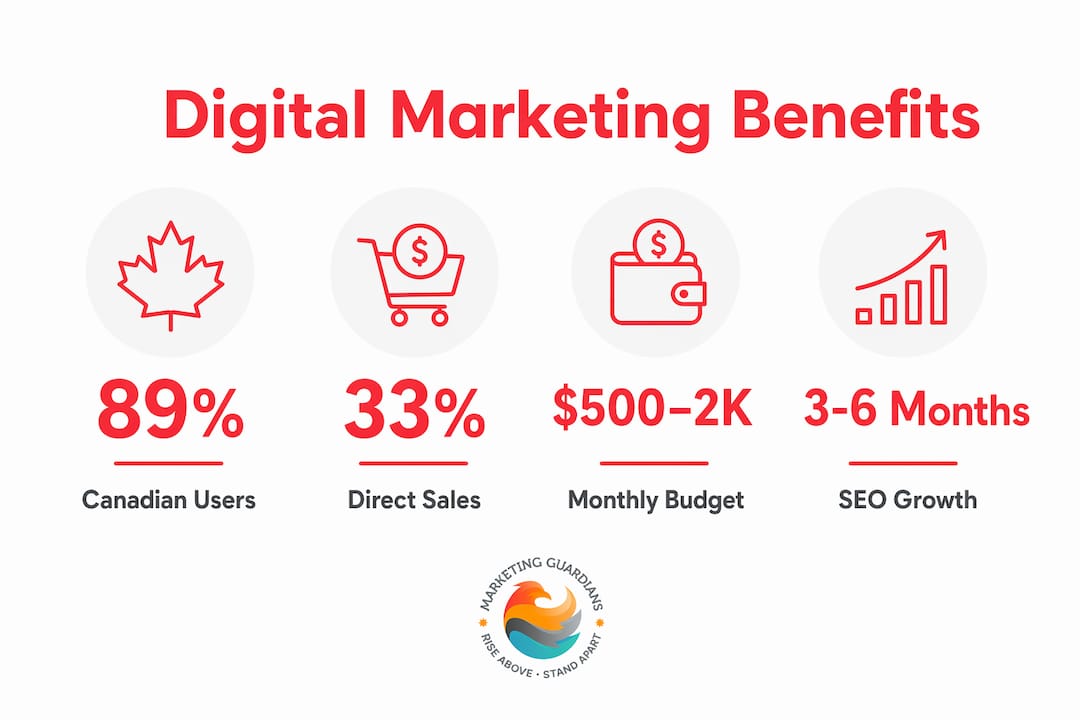
- Stronger local visibility and review-driven trust. Roughly 89% of Canadians use digital channels to discover brands. Reviews are a critical part of that discovery process, and a business with 50 recent, well-responded-to reviews consistently outperforms one with 10 older ones in local search rankings.
- Compounding value from content and SEO. A paid ad stops the moment you stop paying. A well-written service page or FAQ article can generate organic traffic for years. Consistent, focused investment in a few channels builds cumulative value that early-stage spend alone cannot buy.
Pro Tip: Before chasing the loudest channels, check where your competitors are underinvested. BDC data shows that businesses often pile into the same visible channels while buyers search across many others. A less crowded channel with real demand can deliver a stronger digital marketing ROI.

When does digital marketing deliver real value?
Digital marketing is infrastructure, not a switch. It performs best when certain conditions are already in place. Use this quick self-assessment before committing budget:
- ✅ There is existing search demand for your product or service in your area
- ✅ You serve a defined local or regional geography (Alberta, a specific city, a service radius)
- ✅ You have capacity to fulfil new leads without a long delay
- ✅ Your website loads quickly on mobile and clearly explains what you do
- ✅ You have at least a handful of genuine customer reviews
- ✅ You can commit to consistent monthly investment for at least 90 days
- ✅ You have a basic way to track enquiries (phone, form, booking)
If most of those boxes are checked, digital marketing is likely to pay off. If several are missing, fix the fundamentals first. Spending on paid ads while your website is slow or your Google Business Profile is unclaimed is operating in the dark.
Pro Tip: CFIB data shows only 33% of Canadian small businesses with websites use them for direct sales. If your site is purely informational, that is fine — but make sure it is structured to generate enquiries (phone number prominent, contact form visible, clear calls to action) before you drive paid traffic to it.
How do you measure the impact of digital marketing?
Start with a simple KPI hierarchy: visibility → demand → conversion → value. Track these in order and you will always know where the bottleneck is.
Core KPIs for small businesses:
- Search impressions (Google Search Console, Google Business Profile)
- Website sessions and traffic source breakdown
- Phone calls and form submissions (track these as conversions in Google Analytics 4)
- Cost per lead (total ad spend ÷ leads generated)
- Conversion rate (leads ÷ sessions)
- Customer lifetime value (LTV), even as a rough estimate
For attribution, most small teams do well with last-click attribution in the early stages. As you add channels, move to assisted-channel reporting in Google Analytics 4 to see which touchpoints contribute before the final conversion. The most important digital marketing metrics to watch shift as you grow, but visibility and lead volume are always the starting point.
| Discovery behaviour | Stat |
|---|---|
| Canadians using digital channels to discover brands | 89% |
| Canadians checking reviews before buying | 87% |
| Small businesses using Google Business Profile | 52% |
Pro Tip: Set up phone call tracking and booking-form submissions as conversion events before you do anything else. These low-friction conversions are the most common way small businesses generate revenue online, and they are frequently left unmeasured.
A practical 30–90 day action plan for Alberta small businesses
- Days 1–30: Claim and complete your Google Business Profile. Audit your website for mobile speed and clear contact information. Ask five recent customers for a Google review. Launch one small paid search test on your highest-intent keyword. Set up Google Analytics 4 with phone-call and form-submission tracking.
- Days 31–60: Publish two to three pieces of content answering your most common customer questions. Fix any local SEO gaps (consistent name, address, phone number across directories). Refine your paid campaign based on early data. Respond to every review, positive or negative.
- Days 61–90: Review your KPI data and double down on the channel producing the lowest cost per lead. If organic traffic is growing, invest in more content. If paid ads are converting well, increase the budget incrementally. If capacity is limited, consider a subscription-based digital marketing service rather than managing everything in-house.
Quick brief template (paste into a vendor or internal brief):
- Goal: X new leads per month within 90 days
- Geography: [City/region], Alberta
- Primary offer: [Your main service or product]
- Budget: $[amount]/month
- KPIs: Cost per lead, conversion rate, monthly lead volume
What do typical costs and timelines look like in Canada?
Expectations matter as much as strategy. Here is a realistic picture for Alberta small businesses:
- Paid ads stabilise in a few weeks but require ongoing management and testing
- Local SEO typically shows meaningful movement in 3–6 months
- Content marketing builds compounding traffic over 6–12 months
- Review and reputation actions can show results within days of a concerted push
| Tactic | Typical timeline | Small-business budget range |
|---|---|---|
| Google Ads (paid search) | Weeks to stabilise | $500–$2,000/month (ad spend + management) |
| Local SEO | 3–6 months | $300–$1,500/month |
| Content marketing | 6–12 months | ~$300/month |
| Social media management | Ongoing | — |
| Google Business Profile setup | Immediate | DIY or one-time fee |
DIY approaches save money upfront but cost time and often produce slower results. A monthly subscription model spreads cost predictably and keeps strategy consistent, which is where content assets tend to compound most effectively for small teams.
Pro Tip: Structured, question-answering content on your website is one of the most underinvested channels for Alberta small businesses. As AI-assisted discovery grows, clear structured content increases the likelihood that AI tools recommend your business, at no additional ad spend.
Real-world proof: what measurable results look like
Marketing Guardians has worked with Alberta small businesses across service industries. While every result depends on starting conditions and competitive context, the patterns are consistent.
- Local service business (home services, Calgary area): After claiming and optimising their Google Business Profile and running a focused local SEO effort, a client saw organic search impressions increase significantly within four months, translating to a measurable increase in inbound calls per week. The lesson: Google Business Profile optimisation is the highest-leverage starting point for most local businesses.
- Professional services firm (Edmonton): A content strategy targeting specific buyer questions produced a steady increase in qualified website sessions over six months, with cost per lead dropping as organic traffic grew. The lesson: content that answers real questions compounds over time in a way that paid ads alone cannot replicate.
- Retail and e-commerce (Alberta): A combined Google Ads and social media management approach produced a measurable reduction in cost per acquisition within the first 60 days of campaign refinement. The lesson: paid channels need active management and data-driven adjustments to perform, not just a launch.
Key takeaways
Digital marketing’s most durable advantage for small Canadian businesses is that consistent, targeted investment builds compounding visibility and lead flow that traditional advertising cannot match at the same cost.
| Point | Details |
|---|---|
| Reviews drive decisions | Reviews influence 87% of Canadians before they buy; managing your reputation is non-negotiable. |
| Fundamentals first | Website speed, Google Business Profile, and call tracking must be in place before scaling spend. |
| Timeline varies by tactic | Paid ads stabilise in weeks; local SEO takes 3–6 months; content compounds over 6–12 months. |
| Measure what matters | Track visibility, leads, conversion rate, and cost per lead — in that order. |
| Marketing Guardians | Offers subscription-based SEO, paid ads, content, and social management tailored to Alberta small businesses. |
Why digital marketing requires honest expectations
Most small businesses underestimate how much the early months of digital marketing are about buying data, not revenue. You run a paid campaign and learn which keywords convert. You publish content and learn which questions your buyers actually ask. You track calls and learn which channel drives the most qualified enquiries. That data is the real return on early investment, and it compounds into better decisions and lower costs over time.
The businesses that struggle with digital marketing are usually the ones that expected immediate results, switched channels before the data was meaningful, or treated it as a one-time project rather than an ongoing system. The ones that succeed pick two or three channels, measure consistently, and adjust based on what the numbers show. That is not a complicated strategy. It is a disciplined one.
How Marketing Guardians supports Alberta small businesses
If you have read this far, you already understand that digital marketing works best as a consistent, data-driven system rather than a series of one-off campaigns. Marketing Guardians delivers exactly that through a subscription model designed for Alberta small businesses: SEO, Google Ads management, social media management, content creation, and monthly reporting, all coordinated around your specific goals and service area.

A typical 90-day engagement starts with a baseline audit, moves into channel prioritisation and campaign setup, and closes with a clear picture of cost per lead and which channels to scale. You get a dedicated team without the overhead of a full-time hire, and no long-term contract locks you in. If you are ready to build a digital presence that generates consistent enquiries in Alberta, the Alberta small business digital marketing guide is a good place to start, or reach out directly to discuss what a subscription plan would look like for your business.
FAQ
What are the main benefits of digital marketing for small businesses?
The primary advantages are measurable visibility, precise local targeting, and compounding value from SEO and content. Unlike traditional advertising, every channel produces data you can act on to lower your cost per lead over time.
How long does it take to see results from digital marketing in Canada?
Paid ads typically stabilise within a few weeks. Local SEO shows meaningful movement in 3–6 months, and content marketing builds compounding traffic over 6–12 months.
How much should a small Alberta business spend on digital marketing?
Budget ranges vary by tactic: Google Ads typically runs $500–$2,000 per month including management, while local SEO and content services range from $300–$1,500 per month. Starting with one focused channel and measuring results before expanding is the most cost-efficient approach.
When should a small business hire a digital marketing agency instead of doing it themselves?
When the time cost of managing campaigns exceeds the cost of professional help, or when results have plateaued despite consistent effort, a subscription-based digital marketing service typically delivers better ROI than DIY.
Does digital marketing work for service businesses in Alberta?
Yes, particularly through local SEO and Google Business Profile optimisation. With 89% of Canadians using digital channels to discover businesses, a well-maintained local presence consistently generates inbound enquiries for service-area businesses.
Recommended

Get Your Free Guide
Download our comprehensive guide to improve your marketing strategy.


