
A branded advertisement is paid creative designed primarily to build awareness, recognition, and long-term brand equity rather than drive an immediate conversion. Before anything else, confirm that your logo, brand colours, and core voice appear early in every creative execution and that your KPIs reflect brand outcomes, not just clicks.
Table of Contents
- What a branded advertisement actually does
- How branded advertising differs from performance marketing
- Which channels and formats work for branded campaigns in Canada
- How to plan a branded advertising campaign step by step
- How to measure whether your branded advertising is working
- Canadian legal and industry rules you need to follow
- Common branded-advertising mistakes and how to fix them
- How Marketing Guardians approaches branded advertising
- Key takeaways
- Why brand investment is the part most businesses underestimate
- Marketing Guardians helps Alberta businesses build brand presence
- Useful sources and further reading
- FAQ
What a branded advertisement actually does
At its core, branded advertising is a long-term strategy that applies a company’s identity consistently across paid media to build mental availability. When a consumer thinks of a product category, the goal is for your brand to surface first. That does not happen by accident.
The components that make it work:
- Distinctive assets: logo, colour palette, tagline, and sonic identity applied consistently across every placement
- Emotional or storytelling creative: narratives that connect with audiences intellectually and emotionally, not just rationally
- Consistent brand voice: the same tone and personality whether the ad runs on CTV, a billboard on Deerfoot Trail, or a sponsored Instagram post
- Repeated media exposure: frequency matters because memory is built through multiple touchpoints over time
The primary outcomes are awareness, ad recall, consideration, and preference. These are upstream of conversion, which is exactly the point. A consumer who has never heard of your brand is far less likely to click your performance ad when they finally see it.
How branded advertising differs from performance marketing
The two approaches are not rivals. They serve different parts of the same funnel.
| Dimension | Branded advertising | Performance marketing |
|---|---|---|
| Primary goal | Awareness, recall, brand equity | Clicks, leads, conversions |
| Key metrics | Brand lift, reach, impressions, ad recall | CPA, ROAS, CTR |
| Typical channels | TV, OOH, CTV, display, sponsorships | Paid search, retargeting, social direct response |
| Timeline | Long-term (months to years) | Short-term (days to weeks) |
| Creative focus | Emotion, storytelling, brand identity | Offer clarity, urgency, CTA |
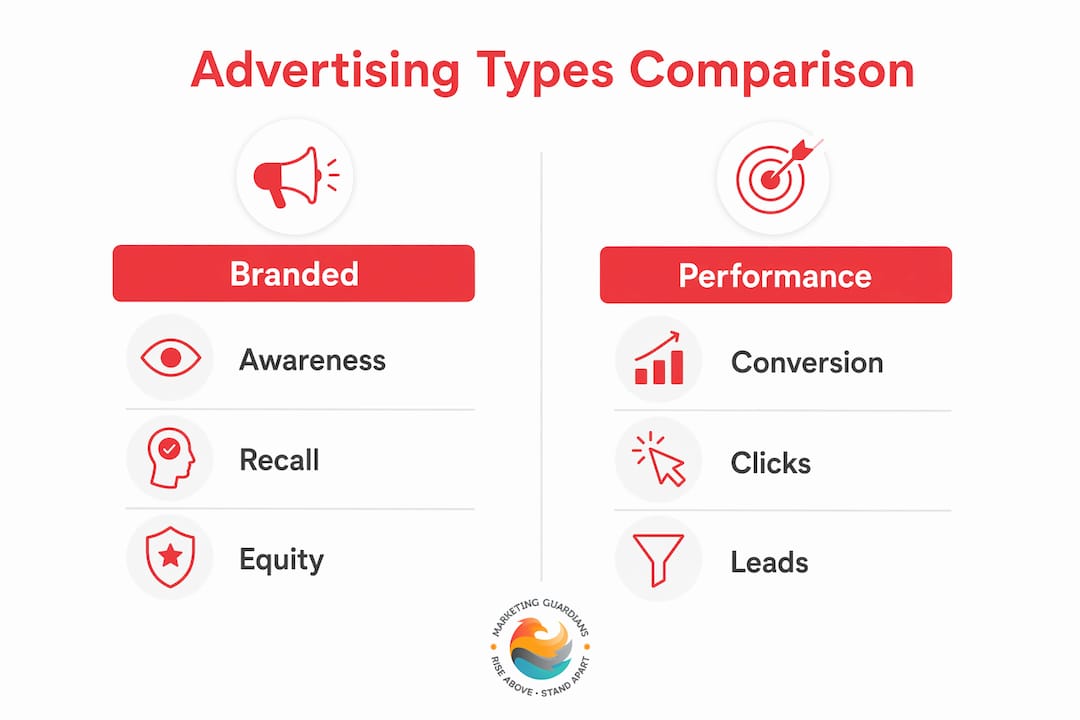
The brandformance model resolves the false binary. You build top-of-funnel demand with brand advertising, then capture that demand with performance channels. Practically, this means your brand campaign and your PPC campaign should share visual language and messaging so the consumer who saw your awareness ad recognises your search result later. Aligning ads with landing pages is one of the highest-leverage moves in a blended strategy. Strong branding also improves ad effectiveness measurably, which means your performance budget works harder when your brand is already known.
Which channels and formats work for branded campaigns in Canada
High-reach formats remain the backbone of brand building:
- Television and CTV: still the highest-reach environment in Canada; connected TV is growing rapidly and allows precise audience targeting alongside the emotional impact of video
- Out-of-home (OOH): transit shelters, digital billboards, and large-format outdoor placements in Calgary and Edmonton deliver sustained local frequency
- Radio: strong in Alberta commuter markets; effective for brand voice and sonic identity
- Programmatic display: awareness-focused buys using CPM pricing, optimised for viewability and reach rather than clicks
- Paid social: Meta, TikTok, and LinkedIn support video and carousel formats that carry brand storytelling to defined audiences
- Native and sponsored content: long-form editorial placements that build credibility and brand association without hard-sell creative
- Influencer partnerships: authentic creator content that extends brand reach, provided disclosure obligations are met
Pro Tip: Under Ad Standards Canada’s Influencer Disclosure Guidelines, any influencer who receives payment, free product, or any other benefit must clearly disclose that relationship in the content itself. “Ad,” “#sponsored,” or “#partner” at the start of a caption meets the standard; burying disclosure in a long hashtag string does not. Authenticity and transparency are increasingly important to Canadian audiences, and non-disclosure can trigger a Competition Bureau enforcement action.
How to plan a branded advertising campaign step by step
- Define the mental cue. Decide what single association you want consumers to hold about your brand. Every creative decision flows from this.
- Audit your brand assets. Confirm logo, colour palette, tagline, and tone are documented and available to all creative partners before briefing begins.
- Write the creative brief. Include mandatory brand linkage rules (logo placement, early appearance), tone guidelines, and any required legal or regulatory lines under the Canadian Code of Advertising Standards.
- Build the media plan. Set reach and frequency targets by channel, define flight dates, and sequence formats so awareness placements precede consideration formats.
- Set measurement up front. Identify your primary brand KPIs, establish a baseline, and plan a test-versus-control approach before the campaign launches.
- Budget for duration. Brand campaigns require sustained exposure. A two-week flight rarely moves awareness metrics; plan for a minimum of eight to twelve weeks.
- Ask your agency the right questions. Before signing off, confirm how brand linkage will be enforced in creative, how measurement will be reported, and what the creative refresh cadence looks like.
How to measure whether your branded advertising is working
Brand measurement requires multiple methods, not a single metric. Effective measurement combines survey-based lift studies with passive behavioural signals.
Brand-centric KPIs include aided and unaided awareness, ad recall, brand consideration, and preference. These require survey data collected from exposed versus unexposed groups. A formal brand lift study, available through platforms such as Meta Brand Lift or YouTube Brand Lift, runs this comparison automatically within a campaign.

Behavioural proxies are faster and cheaper. Branded search growth, measured by tracking your brand name’s search volume in Google Search Console before and during a campaign, is a reliable signal that awareness is building. Share-of-voice data from tools like SEMrush adds a competitive dimension.
Attention modelling tools predict whether creative will hold a viewer’s attention long enough to encode the brand. These are useful at the pre-production stage to avoid spending media budget on creative that will not be remembered.
A simple search-lift check: pull branded query volume from Google Search Console for the four weeks before your campaign, then compare it to the four weeks during the flight. A consistent upward trend in branded queries, without a corresponding spike in paid branded search spend, is a strong signal that your awareness campaign is working.
Canadian legal and industry rules you need to follow
Compliance is not optional, and the consequences of getting it wrong range from mandated ad removal to regulatory action.
- Ad Standards Canada administers the Canadian Code of Advertising Standards, which covers truthfulness, accuracy, and disguised advertising. Advertisers must substantiate claims promptly when asked. Non-compliance can result in mandatory removal or amendment of the advertisement.
- Competition Act: at the federal level, false or misleading representations are prohibited. This applies to all advertising, including influencer content.
- Influencer disclosure: material connections must be disclosed clearly and prominently in the content itself, per both the Competition Act and the Ad Standards Influencer Disclosure Guidelines.
- Government of Alberta CPE pre-approval: the Government of Alberta requires that provincial advertising be pre-approved through Communications and Public Engagement (CPE). During legislated election, by-election, or referendum periods, advertising by government departments and Provincial Corporations is prohibited except for narrow exceptions such as emergencies or legally required communications. Any agency or supplier working with Alberta government entities must build CPE pre-approval into the campaign timeline.
- Substantiation readiness: keep documentation supporting all advertised claims on file before the campaign launches, not after a complaint arrives.
Common branded-advertising mistakes and how to fix them
- No early brand linkage: if the logo appears only at the end of a video, most viewers will not connect the creative to your brand. Fix: mandate logo placement within the first three seconds of any video asset.
- Weak creative distinctiveness: generic imagery and stock photography do not build memory. Fix: invest in distinctive visual assets that are ownable and consistent across placements.
- Flights that are too short: a two-week campaign rarely moves brand metrics. Fix: commit to a minimum of eight weeks and plan creative refreshes to maintain attention without causing wear-out.
- Insufficient frequency: reaching one million people once is less effective than reaching one hundred thousand people ten times. Fix: set a minimum frequency target in your media plan and monitor it weekly.
- No measurement baseline: without pre-campaign data, you cannot demonstrate lift. Fix: run a baseline awareness survey or pull branded search data before the first impression is served.
Red flag: if your creative team cannot name the single brand association the campaign is designed to build, pause the brief and restart.
How Marketing Guardians approaches branded advertising
Marketing Guardians works with Alberta businesses on subscription-based digital marketing that integrates branded advertising planning, creative production, media execution, and measurement reporting into a single ongoing engagement. The subscription model means clients receive continuous optimisation rather than a one-off campaign handoff.
A typical engagement includes:
- Challenge identification: auditing existing brand assets and identifying gaps in awareness or recall relative to competitors
- Branded campaign build: developing creative that meets brand linkage standards and aligns with the Canadian Code of Advertising Standards
- Measurement setup: establishing baseline branded search volume and configuring brand lift tracking before launch
- Ongoing optimisation: monthly creative refresh reviews, audience sequencing adjustments, and measurement re-tests to confirm the campaign continues to build equity
Clients benefit from digital marketing reach strategies that connect brand and performance channels so awareness investment translates into measurable downstream results.
Key takeaways
Branded advertising builds long-term equity by combining consistent creative assets, sustained media exposure, and rigorous measurement across brand-centric KPIs rather than short-term conversion metrics.
| Point | Details |
|---|---|
| Lead with brand linkage | Place your logo and core brand assets within the first three seconds of any video creative. |
| Set measurement before launch | Establish a branded search baseline and plan a lift study before the first impression runs. |
| Commit to duration | Run brand campaigns for a minimum of eight to twelve weeks to move awareness metrics. |
| Comply with Canadian standards | Substantiate all claims, disclose influencer relationships, and for Alberta advertisers, complete CPE pre-approval before launch. |
| Marketing Guardians | Offers subscription-based branded advertising services covering creative, media, measurement, and ongoing optimisation for Alberta businesses. |
Why brand investment is the part most businesses underestimate
Most businesses treat brand advertising as a luxury they will fund after performance marketing pays the bills. That logic is backwards. Performance channels capture demand that already exists; brand advertising creates it. When we look at campaigns where performance costs are rising and conversion rates are flat, the underlying issue is almost always insufficient brand investment upstream. Audiences who have never heard of you are expensive to convert, and no amount of bid optimisation changes that.
The practical implication is that brand and performance budgets should be planned together, with brand work treated as infrastructure rather than discretionary spend. Audit your current creative right now: does your brand appear in the first three seconds? Does your media plan include enough frequency to build memory? If the answer to either question is no, that is where to start.
Marketing Guardians helps Alberta businesses build brand presence
Alberta businesses that want consistent brand growth without the overhead of a full in-house team get exactly that with Marketing Guardians. Our subscription model covers everything from branded social media management and pay-per-click advertising to creative production and brand lift reporting, all under one recurring plan with no long-term contract lock-in.

We tailor every engagement to the client’s brand assets and Alberta market context, so your creative meets Ad Standards Canada requirements and your media plan reflects where your audience actually spends time. To see how a subscription marketing plan fits your business, visit our Alberta digital marketing guide or get in touch for a no-obligation conversation about your brand goals.
Useful sources and further reading
- Ad Standards Canada — Canadian Code of Advertising Standards: the primary self-regulatory document governing advertising content in Canada; essential reading for claim substantiation, influencer disclosure, and comparative advertising rules.
- Government of Alberta — Communications and Public Engagement: the authoritative source for CPE pre-approval requirements and election-period advertising restrictions affecting provincial advertisers and their agency partners.
- Marketing Guardians — digital marketing services: case studies and service descriptions covering branded advertising planning, creative, media buying, and measurement for Alberta businesses.
FAQ
What is a branded advertisement?
A branded advertisement is paid creative that prioritises building awareness, recognition, and brand equity over immediate conversions, using consistent brand assets such as logos, colours, and tone across paid media placements.
How can I advertise my brand effectively in Canada?
Combine high-reach formats such as CTV, OOH, and paid social with a clear brand linkage rule (logo visible early), a minimum eight-to-twelve-week flight, and measurement through brand lift studies and branded search growth tracking.
What is the Government of Alberta’s advertising policy?
The Government of Alberta requires pre-approval of provincial advertising through Communications and Public Engagement (CPE) and prohibits government department advertising during legislated election, by-election, or referendum periods except for narrow exceptions.
What are the main types of advertising?
Advertising broadly divides into branded (awareness and equity focused) and direct-response or performance (conversion focused), with channels spanning television, radio, out-of-home, digital display, paid search, paid social, native content, and influencer partnerships.
How does Marketing Guardians support branded advertising?
Marketing Guardians provides subscription-based services covering creative production, media planning, brand lift measurement, and ongoing optimisation, helping Alberta businesses build consistent brand presence alongside their performance campaigns.
Recommended

Get Your Free Guide
Download our comprehensive guide to improve your marketing strategy.


