Quick answer: Google's May 2026 changes, including AI Mode passing one billion monthly users, background Information Agents, and a Universal Cart rolling out to Canada ahead of the UK, mean businesses now need to be understood and cited by AI systems, not just ranked. The fundamentals still matter, but where they need to show up has expanded.
Key takeaways
- Google AI Mode has passed one billion monthly users, and query volume has more than doubled every quarter since launch.
- Ranking on page one and being cited inside an AI-generated answer are now two different goals. Citation overlap with top organic results can run as low as 17 to 54 percent depending on the category.
- Universal Cart, Google's cross-platform shopping cart, is rolling out UCP-powered checkout to Canada in the coming months, alongside Australia and ahead of the UK.
- Google expanded SynthID and C2PA content verification in May 2026, which means AI-generated content can now be labelled and identified at scale.
- None of this replaces SEO fundamentals. Clear, specific, well-structured content backed by real expertise still does most of the work.
What did Google actually announce in 2026?
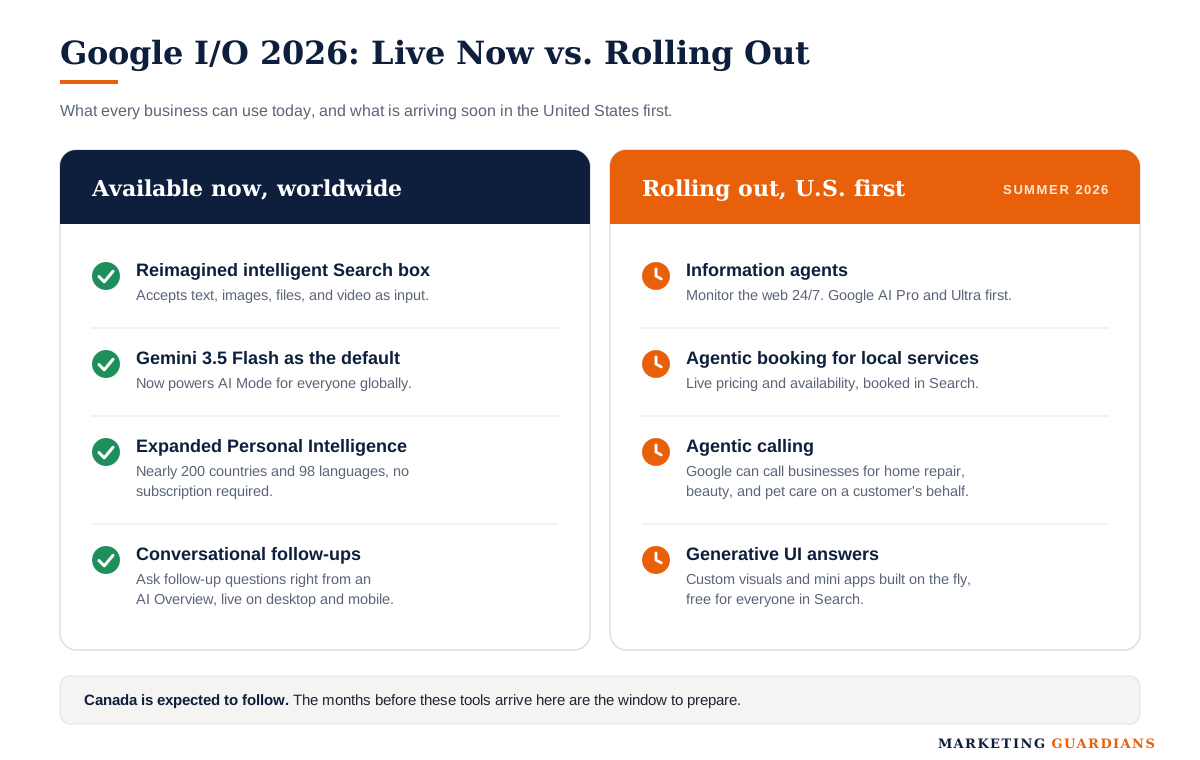
In May 2026, Google rebuilt how its search engine works. AI Mode, the conversational version of Google Search, has passed one billion monthly users, and it is showing up more and more even when someone types a normal search. Google also announced background AI agents that keep watching the web for people, a rebuilt search box built for full questions instead of two-word searches, and a shopping cart called Universal Cart that is rolling out to Canada specifically, ahead of the UK.
None of this means you need to panic or rebuild your website tomorrow. It does mean the definition of showing up on Google has expanded, and businesses that only optimize for the old version of search are going to lose ground to ones that adapt.
Why isn't Google sending as many people to websites anymore?
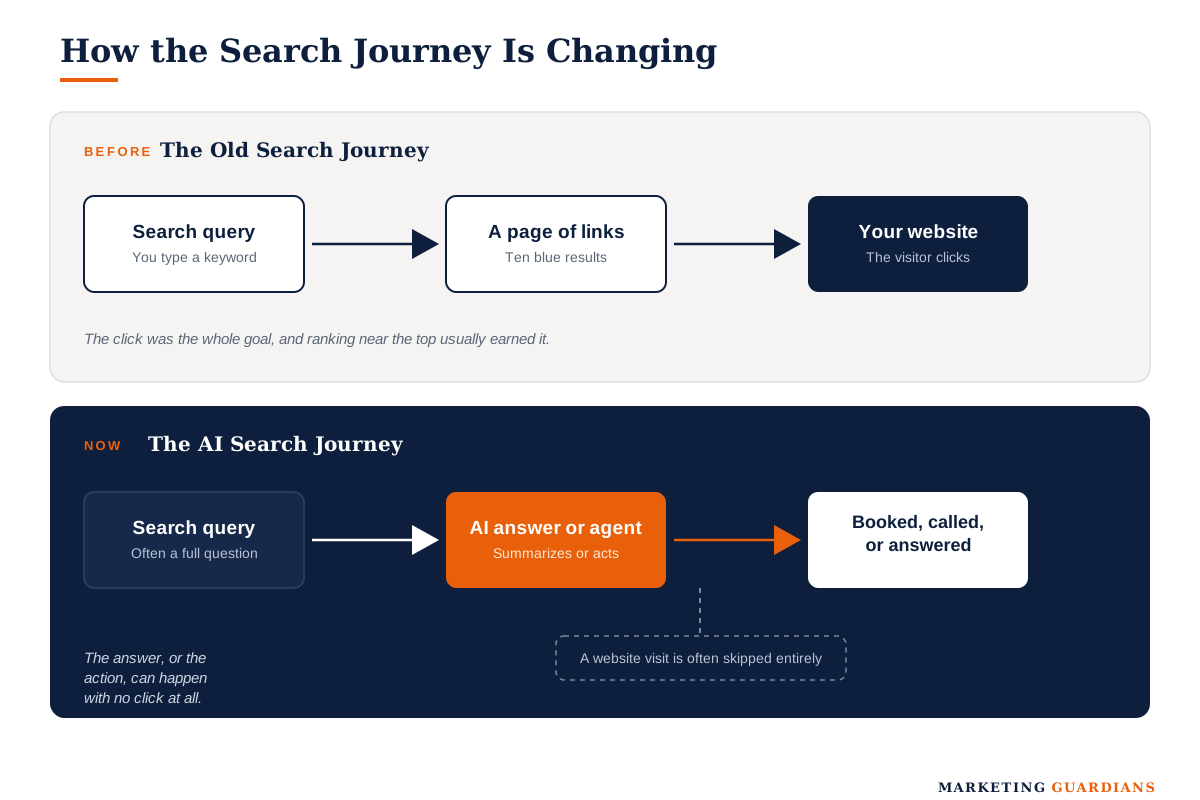
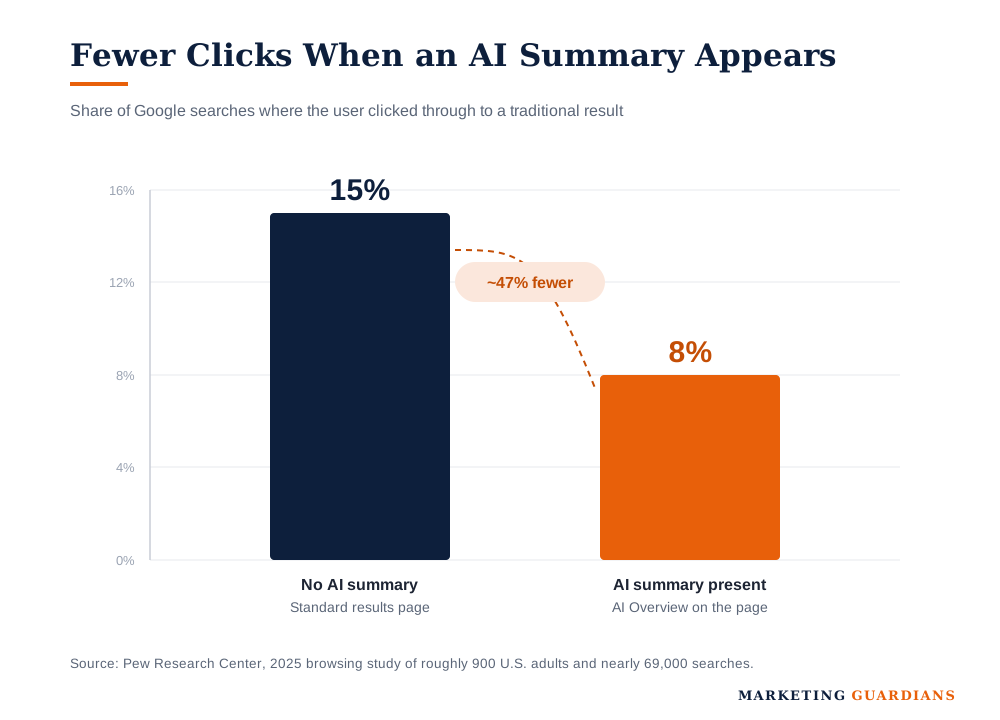
For twenty years, the job of a website was simple. Rank high enough that someone clicks through. That is still true, but it is no longer the whole picture. When someone asks Google a question now, there is a real chance they get a complete answer without visiting anyone's website at all.
We saw this play out with a Calgary based professional services client. Several visibility signals looked healthy. Mobile searches were averaging close to the first page, click-through rates were respectable, and Google Business Profile impressions had risen sharply. Yet roughly 270 profile impressions were producing only seven website visits and two call clicks during the reporting period.
Digging deeper showed this was not a ranking problem. It was an interpretation and conversion problem. The page titles did not clearly identify the service or the Calgary location. Important pages lacked proper headings and structured data. The contact page was thin, the business address was inconsistent, and the profile was attracting attention without giving people a compelling next step. The site was visible, but Google and potential customers still had to work too hard to understand who the business served, where it operated, and why someone should reach out.
That gap matters more as Google answers questions directly. A business can appear in traditional results and still be excluded from the answer, recommendation, or shortlist Google assembles. Rankings remain valuable, but being found is no longer enough. You also need to be understood, trusted, and easy to act on.
Why can a business rank well and still be invisible to AI answers?
Ranking on page one of Google and showing up inside an AI-generated answer are two different things now. Some research has found that the sources Google's AI cites overlap with the traditional top ten results as little as 17 to 54 percent of the time, depending on the category. A meaningful share of what shows up in AI answers is not coming from the pages ranking highest in classic search.
What does it mean to be "cited" by Google's AI?
Being cited means Google's AI pulled a specific claim, fact, or answer from your page and used it, sometimes with a visible link, sometimes without one you would notice unless you went looking. The pages that get cited share a few traits. They answer the actual question early. They are specific rather than vague. They are backed by real expertise rather than generic advice that could describe any business in any city.
Most business owners write their website from the inside out. They lead with their history, capabilities, process, and list of services. Meanwhile the visitor is trying to answer three much simpler questions. Is this for me. Can you solve my particular problem. What should I do next.
PALC is a good example of what happens when a page tries to answer those questions for everyone at once. Their online messaging was trying to speak to everyone, and as a result it was connecting deeply with almost no one. We clarified the audience, built the message around the learner's desired future, improved the landing pages, and connected each campaign to a clearer next step. As part of the broader targeting and campaign overhaul, conversions increased by 229 percent while ad spend dropped by 33 percent.
The same principle now applies to AI citations. Google cannot confidently extract a useful answer from a paragraph filled with general statements about quality, commitment, and service excellence. The page needs to make a specific, defensible claim early, then provide the evidence underneath it. Our rule is simple. Answer first, explain second. Clarity does not make the content shallow. It gives the reader, and the machine reading on their behalf, a reason to keep going.
This is also where a common objection comes up. Business owners worry that publishing a pricing range, a timeline, an eligibility requirement, or a direct answer will let a competitor copy it or let a prospect walk away without calling. Our answer is that the answer is not the entire product. The product also includes judgement, implementation, customization, accountability, and the ability to handle exceptions. Giving someone a useful answer demonstrates expertise.
Hiding basic information mostly demonstrates that you would rather collect a lead than help someone. Putting the clearest answer near the top, followed by the conditions that can change it, does not give away the work. It removes uncertainty, helps prospects self-qualify, and gives Google something concise it can cite while the surrounding detail shows why your business is still the one worth contacting.
How does this affect Canadian e-commerce and product sellers?
This part matters specifically if you run an e-commerce business or work with clients who do. Google announced Universal Cart, a shopping cart that follows a customer across Search, Gemini, YouTube, and Gmail, and confirmed that checkout powered by this system is expanding into Canada in the coming months, alongside Australia and ahead of the UK.
A shopper can add products from several retailers into one cart, and Google checks in the background for better prices or availability from competitors. Checkout can happen through Google Pay without the customer ever landing on your website, though you remain the merchant of record and keep the customer relationship and data.
This cuts both ways. It can mean fewer abandoned carts and less friction. It can also mean a shopper compares you to a competitor automatically inside Google's own interface before you get a chance to make your case. When price, availability, identifiers, images, or descriptions are incomplete, a retailer can be filtered out before the shopper ever has a chance to visit the site.
We saw exactly how much this matters with CalFast, an industrial tools and fasteners retailer with an enormous online catalogue. Their challenge was never just getting products uploaded. It was making thousands of listings accurate, understandable, and useful across Google Shopping, free listings, and dynamic remarketing. A large catalogue can technically be live while still performing poorly, with unclear titles, misaligned inventory status, incomplete identifiers, and useful detail buried in descriptions neither Google nor customers can interpret quickly.
We treated the product feed as part of the customer experience rather than a technical file to upload and forget. We organized and improved the product information, strengthened search and navigation, streamlined checkout, and structured advertising around specific brands, products, and promotions instead of treating the catalogue as one giant bucket. Once the product data, website experience, and advertising structure began working together, CalFast saw website traffic increase by 58 percent over two years, Google Ads ROI increase by 286 percent, phone leads increase by 86 percent, and online purchases increase by 155 percent.
Feed cleanup alone did not produce every one of those gains. It was part of a broader commerce overhaul. But the feed was foundational, because Google cannot confidently advertise, compare, or recommend a product it does not clearly understand. CalFast did not wait for a platform to force better product access and a lower friction buying journey. It improved those foundations early and benefited as customer behaviour shifted, which is exactly the position Canadian retailers want to be in as Universal Cart rolls out here.
One mistake shows up more often in Canadian product and service listings than almost anywhere else: under localization. Many Canadian websites are built on American defaults and never fully corrected. We regularly find en_US locale settings on Canadian businesses, poorly formatted postal codes, inconsistent addresses, generic national service pages, American terminology, and product feeds that do not clearly communicate Canadian shipping, currency, or availability. Individually these details seem minor. Collectively they make a business harder for Google to verify, at exactly the moment verification is becoming more important to how these systems recommend a business at all. Canadian companies do not need to be louder than American competitors. They need to be more precise about where they operate, who they serve, and how customers can buy from them.
What should a Canadian business do about this right now?
You don't need a new website and you don't need to overhaul your marketing overnight. Three things are worth real attention over the next 90 days.
- First, look at how your most important pages open. If the answer to the question someone is actually asking is buried three paragraphs down, move it up.
- Second, keep your information current and consistent everywhere it appears, not just on your own website. Your Google Business Profile, product listings, social presence, and directory listings are all inputs these AI systems can pull from now. Treat your profile as an active customer acquisition channel rather than a listing you complete once and forget. Categories, services, hours, photos, reviews, posts, booking links, and contact information all affect whether Google can confidently recommend and act on your business.
- Third, if you are using AI to help write content, make sure a real person with real judgement reviews every piece before it goes live. Our own rule is that AI can accelerate the first draft, but it cannot own the claim, the judgement, or the final decision. We start by checking whether the content is factually true, cross-checking material facts against live, publicly accessible sources rather than accepting a confident-sounding sentence at face value. We compare the draft against the client's actual business: are the services current, are the locations and qualifications accurate, does it reflect how the client really works or has AI filled the gaps with generic industry language. We review for usefulness and citability, checking that it answers a real question directly and includes genuine experience rather than observations that could sit on any competitor's site. Then we check voice, Canadian spelling, search intent, and the conversion path, with a senior reviewer giving final sign-off. The last question we ask is always the same. Could any competent company have published this. When the answer is yes, it isn't finished yet.
If this is something that stresses you out and you need help with this, reach out and we'd be happy to help.
Does this replace traditional SEO fundamentals?
It is worth saying plainly that none of this replaces the fundamentals. Google's own guidance, published the same week as these announcements, confirmed that strong, foundational SEO applied consistently is still the complete framework. There is no separate secret playbook for AI search that ignores everything that has worked for years. Clear writing, real expertise, a technically healthy website, and consistent, accurate information across the places customers look are still doing most of the work. What has changed is how many places that foundation now needs to reach, and how quickly a gap in it becomes visible.
Where should you start if you only have time for one thing?
Take the single page most responsible for generating revenue and review only its first screen. Without scrolling, a customer should be able to understand who you help, what problem you solve, where you provide it, why your business is credible, and what they should do next. A search engine or AI system should be able to reach the same conclusions.
Ask someone unfamiliar with the company to look at the page for five seconds and explain what the business offers. When their answer is vague, the page is probably also giving Google an unnecessarily difficult job.
Do not start by producing twenty new blog posts. Fix the page that already matters most. A clearer answer on a commercially important page will usually create more value than adding another generic article to a website that still cannot explain its primary offer.
Frequently asked questions
What is Google AI Mode?
AI Mode is the conversational version of Google Search that generates complete answers to questions using AI, rather than only returning a list of links. It passed one billion monthly users in 2026 and is increasingly the first surface people use to research a business.
Does ranking on page one of Google still matter?
Yes, but it is no longer the whole picture. A business can rank on page one and still be excluded from the answer Google's AI generates, because citation sources and top organic results now overlap as little as 17 to 54 percent of the time depending on the category.
What is Universal Cart and when is it coming to Canada?
Universal Cart is a Google shopping cart that follows a customer across Search, Gemini, YouTube, and Gmail. UCP-powered checkout is rolling out to Canada in the coming months, alongside Australia, ahead of a planned UK launch.
Will Google penalize my website for using AI-generated content?
Google has not announced a blanket penalty for AI-assisted content. Its guidance continues to treat AI use as acceptable when the content is accurate, original, and genuinely helpful. Content published at volume without real editorial oversight is more exposed to being discounted.
What is E-E-A-T and why does it matter more in 2026?
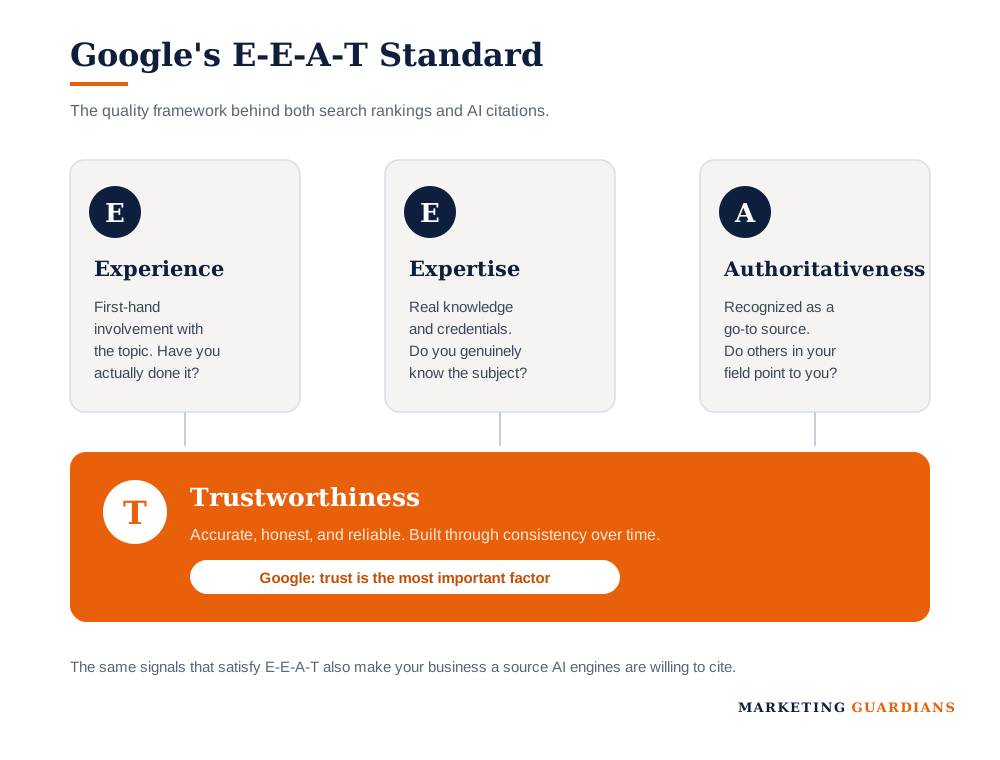
E-E-A-T stands for Experience, Expertise, Authoritativeness, and Trustworthiness. It is the framework Google uses to judge whether content is worth surfacing or citing. It matters more now because AI systems need clear signals of real, first-hand expertise to decide what to cite in a generated answer.
How do I know if my business is being cited in AI search results?
Search your own services and location directly inside Google AI Mode and see whether your business is named in the response. This is the simplest way to check, and it is worth doing regularly rather than once.
Do I need FAQ schema or structured data on my website?
Structured data, including FAQ and Article schema, helps AI systems understand exactly what a page is answering. It will not guarantee a citation on its own, but it removes ambiguity that can otherwise cause a page to be skipped.
Are Canadian businesses affected differently than American ones?
In some respects, yes. UCP-powered checkout is rolling out to Canada ahead of the UK, in the same wave as Australia. Canadian businesses are also more prone to under-localization, including American locale settings and inconsistent address formatting, which can make it harder for Google to verify them.
What is the single most important thing to fix first?
Start with the page most responsible for generating revenue. Make sure its first screen clearly answers who you help, what problem you solve, where you operate, and what to do next, without requiring the visitor to scroll.

Get Your Free Guide
Download our comprehensive guide to improve your marketing strategy.


