The most effective approach to LinkedIn lead generation combines paid Sponsored Content with Lead Gen Forms for volume, organic profile and outreach work for relationship depth, and cost per qualified opportunity as your north-star metric. If you are starting from zero, here is your 30-day plan: allocate a minimum test budget of several thousand CAD, run one Sponsored Content campaign with a Lead Gen Form attached, and send personalised connection requests regularly to your ideal customer profile.
- Primary paid tactic: Sponsored Content with Lead Gen Forms targeting decision-makers by job title, seniority, and company size
- Primary organic tactic: Optimised personal profile plus a weekly content cadence and personalised outreach sequences
- Measurement focus: Cost per qualified opportunity, not raw cost per lead (CPL)
Pro Tip: Set your campaign objective to Lead Generation in Campaign Manager from day one. Choosing the wrong objective, such as Website Visits, locks you into a different bidding algorithm and inflates your CPL before you have collected a single form submission.
Table of Contents
- How LinkedIn lead generation actually works
- Which LinkedIn ad formats should you use for paid lead generation?
- Organic LinkedIn tactics that actually improve lead quality
- How to set up a LinkedIn lead-gen campaign in Campaign Manager
- Measurement, budgeting, and realistic CPL expectations for Canada
- How do you optimise and test a LinkedIn campaign to lower cost per qualified opportunity?
- Key takeaways
- The metric most LinkedIn campaigns get wrong
- Marketing Guardians runs LinkedIn lead-gen programmes so your team can focus on closing
- Useful sources and links to official documentation and benchmarks
- FAQ
How LinkedIn lead generation actually works
LinkedIn operates on two distinct conversion surfaces, and choosing between them shapes everything from your CPL to your lead quality. The first is the native path: a prospect sees your ad in their feed, clicks, and a Lead Gen Form pre-fills with their LinkedIn profile data. No redirect, no load time, no friction. The second is the external path: the click sends the prospect to a landing page on your website, where they fill in a form manually.
What makes LinkedIn different from other paid channels is the quality of its first-party profile data. You can target by job title, seniority level, company size, industry, and even specific company names. For Canadian B2B advertisers, this precision matters because the addressable market in many verticals is smaller than in the US, and wasted impressions are expensive.
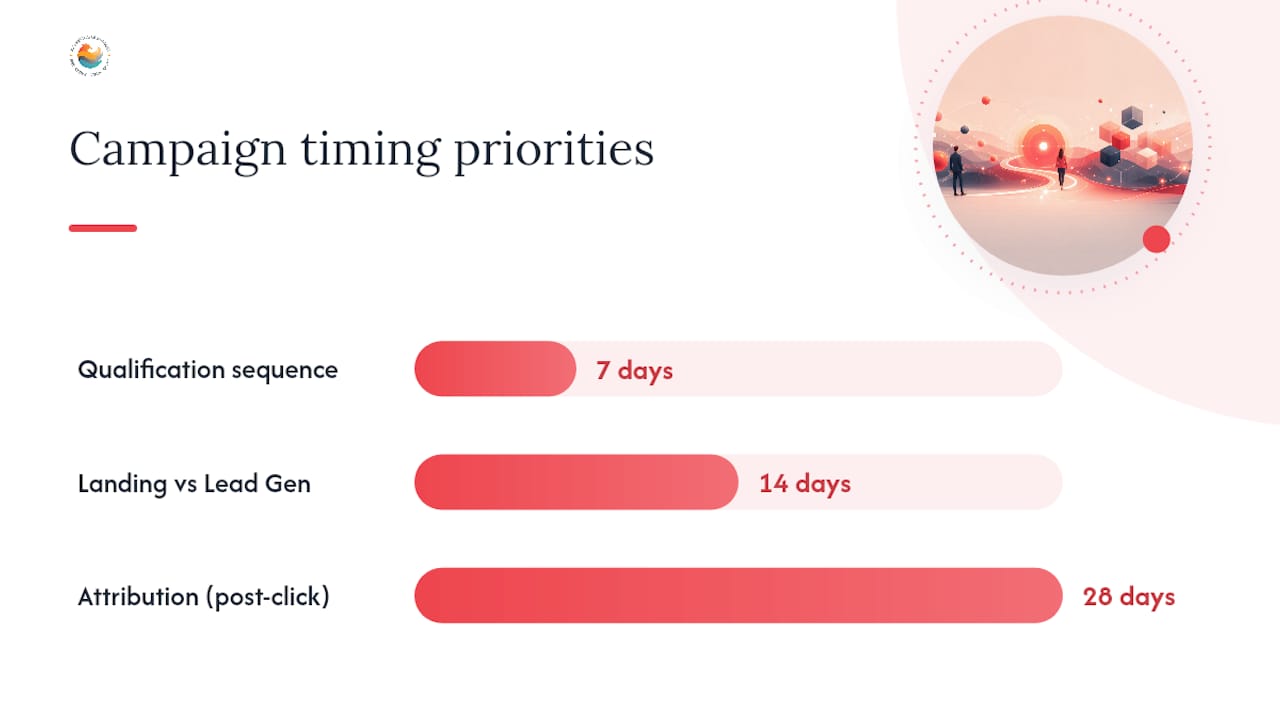
On audience size and budget: LinkedIn’s auction rewards advertisers who give the algorithm room to learn. Audiences below roughly 50,000 members can restrict delivery and inflate CPCs, while audiences above 500,000 often dilute targeting precision for account-based marketing plays. For most Canadian demand-generation campaigns, a sufficiently large audience balances reach with relevance. Attribution windows default to 28 days post-click and 7 days post-view — keep those settings consistent so your reporting reflects actual campaign contribution.
One compliance point Canadian marketers must not skip: any outreach sequence that includes email follow-up after a LinkedIn lead is captured falls under Canada’s Anti-Spam Legislation (CASL). You need express consent or a clear implied-consent basis before sending commercial electronic messages, and your Lead Gen Form’s privacy notice must reflect that. LinkedIn’s form builder includes a customisable privacy policy field — use it.
Which LinkedIn ad formats should you use for paid lead generation?
Start with Sponsored Content paired with Lead Gen Forms. That combination gives you in-feed visibility, pre-filled form convenience, and a CPL that is typically lower than sending traffic to an external page. Once that baseline is running and converting, layer in Message Ads or Conversation Ads for account-based marketing (ABM) plays where you need to reach a named list of target accounts directly.
| Format | Typical CPL range | Conversion rate | Best use case |
|---|---|---|---|
| Sponsored Content + Lead Gen Form | $75–$150 | 8–15% | Demand gen, gated content, webinar sign-ups |
| Sponsored Content + landing page | $100–$250+ | 2–6% | High-intent offers, demo requests, longer qualification |
| Message Ads / Conversation Ads | Varies by list quality | Moderate | ABM, named-account outreach, event invites |
| Document Ads | Lower CPL for awareness | Lower | Thought leadership, multi-page assets |
The trade-off between Lead Gen Forms and landing pages comes down to quality versus volume. Lead Gen Forms reduce friction and can lower CPL by roughly 25–35% compared with external landing pages, but the pre-fill convenience sometimes attracts lower-intent submissions. Landing pages let you add qualification questions, longer copy, and social proof, which filters for higher intent at the cost of a higher CPL.
For Canadian B2B audiences specifically, offers tied to a clear business outcome, such as a free audit, a benchmark report, or a live demo with a named expert, consistently outperform generic “download our guide” creative. Decision-makers in Canada respond to specificity and credibility signals, including client logos, regulatory references, and local case studies.
Pro Tip: Pair your ad creative with the offer’s natural format. A short, punchy single-image ad works well for webinar sign-ups. A carousel or document ad earns more dwell time for complex offers like a multi-step framework or a buyer’s guide. Matching the creative format to the content type reduces drop-off between the click and the form submission.
Organic LinkedIn tactics that actually improve lead quality
Organic LinkedIn prospecting is primarily a labour-cost model. Your CPL is a function of the time your team spends on outreach, content creation, and follow-up, not ad spend. That makes it scalable in a different way than paid: tightening your sequences and improving your profile conversion rate lowers your effective CPL without touching your budget.
Profile optimisation checklist (do these before any outreach):
- Rewrite your headline to state who you help and what outcome you deliver, not just your job title
- Add a clear value proposition in the “About” section’s first two lines (those are visible without expanding)
- Use a professional headshot with a plain or branded background
- Pin a featured post or asset that demonstrates expertise relevant to your ICP
- Optimise your company page with a keyword-rich description, a logo, and a cover image that reflects your current campaign offer
Personalised outreach sequence (7-day cadence):
- Send a connection request with a one-sentence personalised note referencing something specific about their role or company
- On day 3 after acceptance, send a short value-add message: share a relevant insight, article, or data point with no ask
- On day 7, introduce your offer with a single clear question or a soft call to action (“Would a 20-minute conversation be useful?”)
- If no reply, follow up once more on day 14 via LinkedIn, then move the sequence to email if you have express consent under CASL
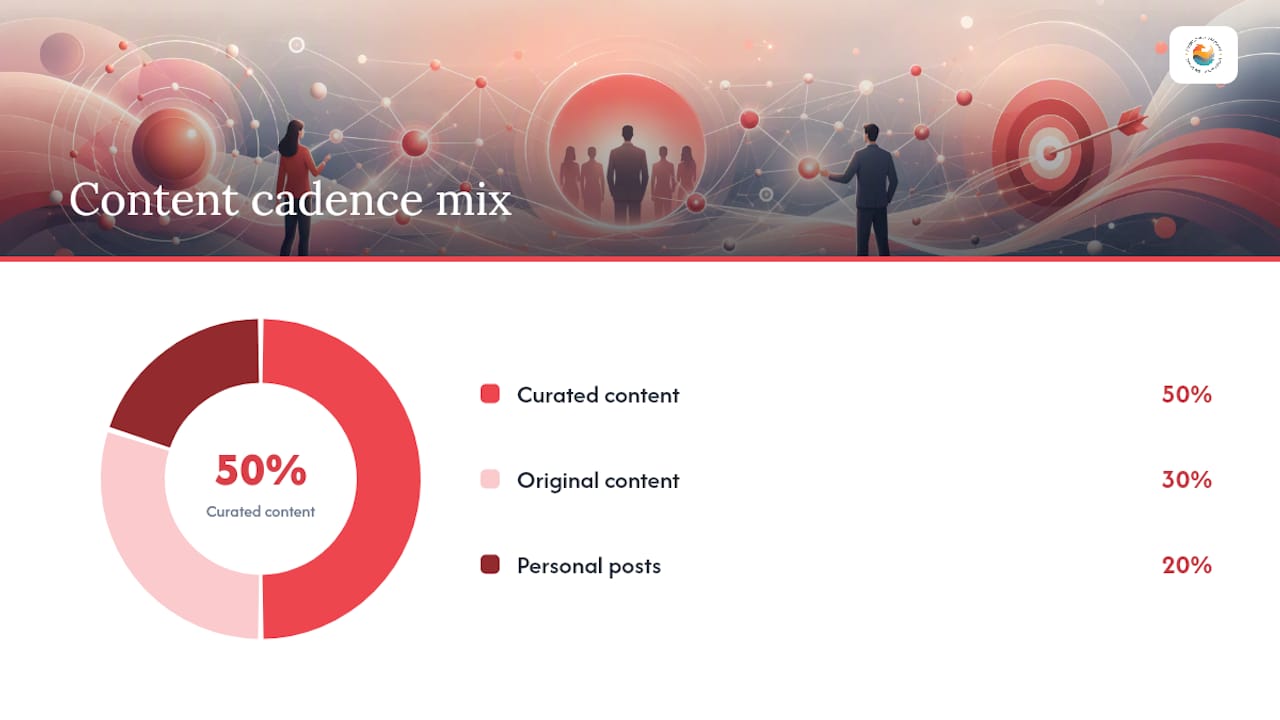
For content cadence, the 5-3-2 rule offers a practical starting framework: for every 10 posts, five should be curated content from external sources relevant to your audience, three should be original content you have created, and two should be personal or humanising posts that show the people behind the brand. This mix keeps your feed from reading like a broadcast channel and builds the trust that makes outreach sequences more effective. Social proof elements, such as client results, testimonials, and third-party recognition, belong in your original three posts.
Multi-channel follow-up, adding a phone call or email after a LinkedIn touchpoint, materially increases reply rates for high-value prospects. Keep the channel switch warm: reference the LinkedIn conversation explicitly so the outreach feels connected, not cold.
How to set up a LinkedIn lead-gen campaign in Campaign Manager
The minimum viable campaign requires five elements: a campaign objective, one or more creatives, a defined audience, a conversion surface (Lead Gen Form or landing page), and conversion tracking. Get all five right before you launch.
Step-by-step setup in Campaign Manager:
- Create a Campaign Group and name it by programme (e.g., “Q3 2026 Demand Gen — Canada”)
- Select the Lead Generation objective at the campaign level — this unlocks Lead Gen Form attachment and optimises bidding for form completions
- Define your audience using the persona dimensions above; set audience size to 80,000–300,000 for demand gen or upload a Matched Audience for ABM
- Choose your ad format: Single Image Ad or Document Ad for most campaigns; Message Ad for direct ABM outreach
- Set bidding to Maximum Delivery for the first 14 days to let the algorithm learn; switch to Manual CPC or Target Cost once you have 30–50 conversions
- Attach or build your Lead Gen Form with the fields below, or link to your landing page if qualification depth is the priority
- Install the LinkedIn Insight Tag on your website and set up a conversion event before launch — without it, you are operating without attribution data
Lead Gen Form field recommendations:
- Always include: First name, Last name, Work email, Job title, Company name
- Optional qualification fields: Company size, Phone number (use sparingly — each additional field reduces conversion rate), a single custom question such as “What is your primary challenge with X?”
- Privacy notice: include a CASL-compliant statement confirming express consent for follow-up communications, and link to your privacy policy
For a 30-day pilot, an adequate budget gives you enough impressions and form submissions to draw directional conclusions. Enterprise plays targeting senior decision-makers at named accounts will need a higher floor, given the smaller addressable audience and higher CPCs in that segment.
Measurement, budgeting, and realistic CPL expectations for Canada
Prioritise cost per qualified opportunity over raw CPL. A campaign generating leads at $80 each looks great until you discover that only 5% of those leads meet your sales qualification criteria. The metric that actually predicts pipeline contribution is cost per sales-qualified lead (SQL) or cost per qualified opportunity, and that is the appropriate number to present to leadership.
B2B channel benchmarks consistently show LinkedIn carrying a higher CPL than search or display, but also a higher average contract value (ACV) for the deals it generates. The comparison that matters is cost-per-SQL across channels, not CPL in isolation.
KPI dashboard for a LinkedIn lead-gen programme:
- Impressions and click-through rate (CTR): directional signal on creative relevance
- Form completion rate: 8–15% is a healthy benchmark for Lead Gen Forms
- CPL by format and offer
- Lead-to-SQL conversion rate: tracked in your CRM post-handoff
- Cost per qualified opportunity: CPL divided by lead-to-SQL rate
- Pipeline influenced: revenue in active opportunities attributed to LinkedIn
| Format / Offer | Typical CPL | Conversion rate | Notes |
|---|---|---|---|
| Lead Gen Form — gated content | $75–$150 | 8–15% | Higher volume, lower intent |
| Lead Gen Form — webinar | $75–$150 | 8–15% | Good for mid-funnel warming |
| Landing page — demo request | $100–$250+ | 2–6% | Lower volume, higher intent |
| Landing page — free audit | $100–$250+ | 2–6% | Strong for service businesses |
For a 30-day pilot, budget guidance for B2B LinkedIn campaigns recommends framing the investment around deal size and CAC payback, not just CPL. Present your CFO with a sensitivity table: if your average deal value is $25,000 and your close rate from SQL is 20%, you need five SQLs to generate one deal. At a $150 CPL and a 10% lead-to-SQL rate, that is 50 leads and $7,500 in ad spend per deal — a straightforward ROI case for most B2B offers.
Benchmark note: LinkedIn CPL benchmarks place Lead Gen Forms at $75–$150 and external landing pages at $100–$250+. Canadian campaigns in smaller verticals often land at the higher end of these ranges due to smaller addressable audiences and higher CPCs.
How do you optimise and test a LinkedIn campaign to lower cost per qualified opportunity?
Test creative and offer first, then audience, then form friction. Creative and offer have the highest variance and the fastest feedback loop; audience and form changes take longer to show statistically meaningful differences.
Experiment sequence:
- Creative test: Run two versions of your ad image or headline with identical audience and offer. Let each accumulate at least 500 impressions before reading results.
- Offer test: Compare a gated content offer against a direct demo request to the same audience. The demo request will have a lower conversion rate but a higher lead-to-SQL rate.
- Form friction test: Compare a short form (4 fields) against a longer form with one qualification question. Measure both CPL and lead-to-SQL rate, not CPL alone.
- Landing page vs Lead Gen Form: Run the same offer on both surfaces to the same audience for 14 days. The Lead Gen Form will almost always win on CPL; the landing page will often win on lead quality.
- Audience test: Compare a broad persona audience against a Matched Audience of target accounts. Expect higher CPL from the Matched Audience but better SQL conversion.
Follow-up playbook:
- Sync leads to your CRM within 24 hours of form submission — lead decay is real and response rates drop sharply after 48 hours
- Assign a follow-up SLA: first contact within one business day for demo requests, within two days for content downloads
- Use a short qualification call or email sequence (3 touches over 7 days) before marking a lead as disqualified
- Tag lead source as “LinkedIn — [Campaign Name]” in your CRM to preserve attribution through the funnel
Pro Tip: Use LinkedIn’s Lead Gen Form webhook or a native integration with your CRM (HubSpot, Salesforce, and Zoho all support direct LinkedIn connections) to eliminate manual CSV exports. The faster the lead reaches a sales rep, the higher your contact rate — and contact rate is the single biggest driver of lead-to-SQL conversion.
For Canadian teams, set your attribution window to 28 days post-click and 7 days post-view in Campaign Manager, and mirror those windows in your CRM reporting. Mismatched windows are one of the most common causes of LinkedIn appearing to underperform relative to other channels.
Key takeaways
Combining paid Sponsored Content with Lead Gen Forms, organic outreach, and a cost-per-qualified-opportunity measurement framework gives Canadian B2B marketers the most reliable path to pipeline on LinkedIn.
| Point | Details |
|---|---|
| Lead Gen Forms lower CPL | Lead Gen Forms typically deliver CPLs of $75–$150, compared with $100–$250+ for external landing pages. |
| Qualify before scaling | Track lead-to-SQL conversion rate alongside CPL; scaling a poorly qualified audience wastes budget. |
| CASL compliance is non-negotiable | Any email follow-up after a LinkedIn lead capture requires express or implied consent under Canadian law. |
| Audience size affects delivery | For Canadian demand-gen campaigns, target an audience of 80,000–300,000 members for efficient delivery. |
| Marketing Guardians | Marketing Guardians runs qualification-first LinkedIn programmes on a subscription model, reporting on cost per qualified opportunity from week two. |
The metric most LinkedIn campaigns get wrong
Most LinkedIn campaigns are measured on CPL, and that is precisely why so many of them disappoint at the pipeline stage. CPL is a media-buying metric. It tells you how efficiently you are acquiring form submissions, not how efficiently you are acquiring revenue. We have seen campaigns with a $90 CPL that generated zero pipeline because the offer attracted the wrong audience, and campaigns with a $200 CPL that produced a 4x return within 90 days because every lead matched the ICP precisely.
The conventional wisdom says to lower your CPL. Our view is that you should first understand what your CPL is buying you. If a $150 lead converts to an SQL at 15%, your effective cost per SQL is $1,000. If a $90 lead converts at 4%, your cost per SQL is $2,250. The cheaper campaign is actually more expensive where it counts.
What this means practically: before you optimise for CPL, set a lead-to-SQL conversion baseline. Run your first 30 days without touching the campaign, pass every lead through a qualification call or email sequence, and measure what percentage reaches SQL status. That number is your real starting point. Everything after that, creative tests, form friction adjustments, audience refinements, should be evaluated against cost per SQL, not cost per form fill.
LinkedIn’s targeting precision makes it uniquely suited to this kind of qualification-first thinking. No other B2B channel lets you filter by seniority, company size, and industry simultaneously before a single dollar is spent. Use that precision to set a high bar from the start, and your CPL will look higher than a poorly targeted campaign — but your pipeline will be real.
Marketing Guardians runs LinkedIn lead-gen programmes so your team can focus on closing
Generating qualified pipeline on LinkedIn takes more than a live campaign. It takes a tested offer, a CASL-compliant form, a CRM integration that fires on day one, and a weekly reporting cadence that tracks cost per qualified opportunity rather than raw CPL. That is the full programme, and it is what Marketing Guardians delivers on a subscription basis with no long-term contract required.
Our LinkedIn advertising service covers campaign strategy, creative development, audience build, form configuration, CRM sync, and weekly performance reporting. SMB clients typically start with a monthly programme that includes one active campaign and bi-weekly reporting. Mid-market and enterprise clients run multi-campaign programmes with ABM overlays, Matched Audiences, and monthly pipeline attribution reviews. Every plan is month-to-month, so you are not locked into a retainer while the programme finds its footing.
If you are ready to move from ad spend to qualified meetings, get in touch with Marketing Guardians to discuss a 30-day pilot scoped to your ICP and budget.
Useful sources and links to official documentation and benchmarks
- Lead Generation | LinkedIn Marketing Solutions
- LinkedIn Lead Gen Forms | LinkedIn Marketing Solutions
- Lead Generation Ads on LinkedIn
- LinkedIn Cost Per Lead 2026: Complete Guide | $75-$200 CPL
- LinkedIn Ads B2B 2026: The Budget Math Your CFO… | DemGen Daily
- B2B Lead Gen Benchmarks 2026: CPL, CVR by Channel | ADV.me
- LinkedIn Cost Per Lead: 2026 Benchmarks by Method | LinkedInsider
- Lead quality vs lead quantity: Why ‘more leads’ can make you less profitable
FAQ
How do you generate leads on LinkedIn?
The most reliable method combines Sponsored Content with Lead Gen Forms for paid volume and personalised connection-request sequences for organic outreach. Set your Campaign Manager objective to Lead Generation, target by job title and company size, and follow up every form submission within one business day.
How much does a LinkedIn Lead Gen Form cost?
LinkedIn does not charge a separate fee for Lead Gen Forms; you pay through your standard campaign budget via CPL or CPC bidding. Benchmark CPL ranges for Lead Gen Form campaigns run $75–$150, compared with $100–$250+ for campaigns sending traffic to an external landing page.
Is LinkedIn good for lead generation?
LinkedIn is the strongest B2B lead-generation channel for reaching decision-makers by title, seniority, and company size, though its CPL is higher than search or display. The channel justifies that cost when your average deal value is high enough that a smaller number of well-qualified leads produces a clear ROI.
What is the 5-3-2 rule on LinkedIn?
The 5-3-2 rule is a content cadence guideline: for every 10 posts, five should be curated third-party content relevant to your audience, three should be original content you have created, and two should be personal or humanising posts. It is designed to keep your feed balanced between value-sharing and self-promotion, which builds the trust that makes outreach sequences more effective.
Recommended

AI search is changing fast. Download our Playbook to make sure you keep up.
Inside our AI Search and GEO Playbook, you’ll find a readiness checklist and a few copy-and-paste building blocks:
- Add Organization, Person, and Service schema to your About and Services pages.
- Add a short FAQ to your top service page with two or three real customer questions.
Small changes like these help AI systems understand who you are, what you do, and when to reference you.
Where to start if you feel behind? Just begin with one page - one question - one clear answer. Then open the Playbook and pick the next small step. Consistency beats intensity here. Your future self will be glad you started this month.


