Discover the best digital marketing subscription for Canadian SMBs in 2026. Boost growth with a full-service plan from Marketing Guardians!
TL;DR:
- Most Canadian SMBs prefer full-service, subscription-based digital marketing that offers predictable growth and flexibility. Marketing Guardians provides a contract-free, cross-channel service including SEO, PPC, social media, content, and creative, with transparent reporting and no long-term commitments. Their model suits businesses seeking measurable results, ownership of ad accounts, and scalable options aligned with their goals.
For most Canadian small and medium-sized businesses, a subscription-based digital marketing service is the clearest path to predictable growth without the overhead of a full-time hire. Marketing Guardians is our recommended pick: a contract-free, full-service subscription that covers SEO, PPC, social media, content, and creative under one monthly plan, with transparent reporting and no locked-in minimums.
TL;DR shortlist:
- Full-service subscription (recommended): SEO + PPC + social + content + creative bundled. Best for SMBs that want one accountable partner. Marketing Guardians fits here.
- Channel-specific subscription: One or two channels only (e.g., SEO or social). Best for businesses with some in-house capacity that need to fill a gap.
- Managed ads + analytics subscription: PPC management with reporting focus. Best for businesses running paid campaigns and needing professional oversight.
Canadian monthly price ranges (services only, ad spend billed separately unless stated):
- Entry-level: a modest monthly fee
- Growth/typical: a moderate monthly fee
- Full-service/enterprise: a higher monthly fee
Subscription-based marketing gives business owners something a one-off project rarely delivers: the kind of predictable recurring revenue and planning confidence that lets you invest in growth rather than scramble for it month to month.
Table of Contents
- How do digital marketing subscription categories compare?
- What does each subscription option actually deliver?
- How do you choose the right digital marketing subscription?
- What should you expect to pay in Canada?
- Why Marketing Guardians? Evidence, case snapshots, and Canadian availability
- What are the recommended next steps?
- Are there cancellation fees or penalties to know about?
- Which Canadian regions and local markets do providers serve?
- How do you verify a provider’s credibility and reviews?
- Key takeaways
- The subscription model most businesses get wrong
- Marketing Guardians gives you a full team, not just a plan
- Useful sources
- FAQ
How do digital marketing subscription categories compare?
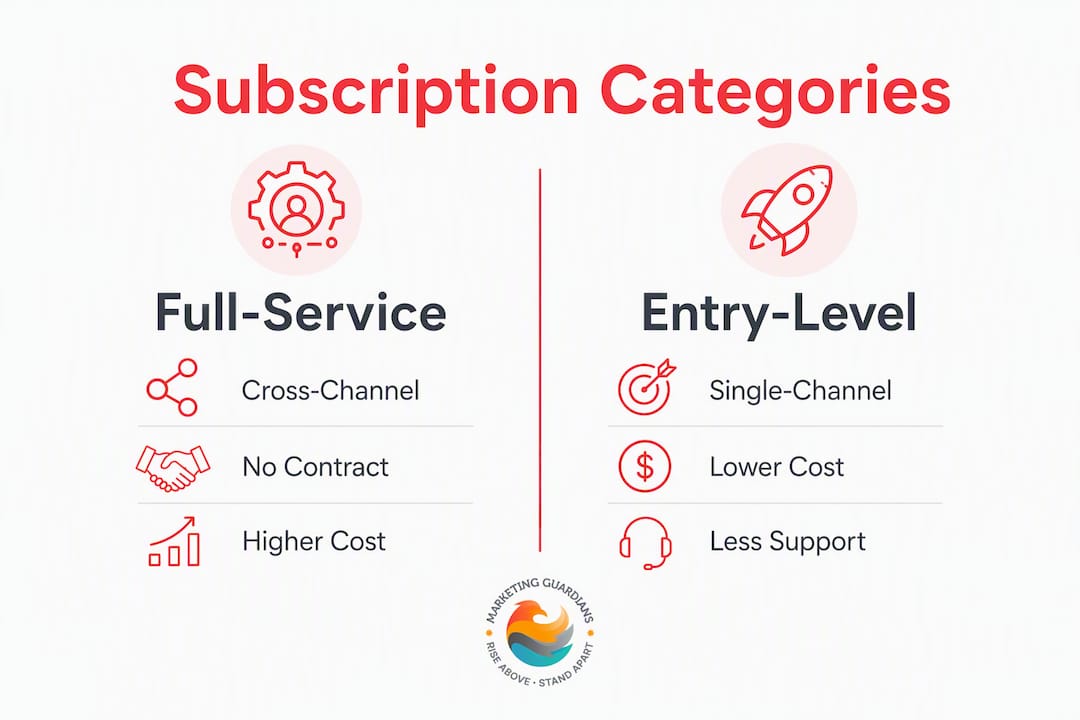
The table below maps three subscription categories against the dimensions that matter most to Canadian buyers. Marketing Guardians sits in the full-service column.

| Dimension | Marketing Guardians (full-service) | Entry-level subscriptions | Ads-first subscriptions |
|---|---|---|---|
| Best for | SMBs, multi-location businesses, B2B services wanting one partner | Startups or solopreneurs with tight budgets | Businesses prioritising paid traffic over organic or content |
| Starting price (CAD/month) | Custom; typically $1,500–$4,000+ | $500–$1,500 | $750–$2,500 (management fee; ad spend separate) |
| Services included | SEO, PPC, social, content, creative, web, analytics, strategy | Usually 1–2 channels; limited creative | PPC + reporting; minimal SEO or content |
| Ad spend | Billed separately; client retains ownership of ad accounts | Billed separately | Billed separately; some include small spend allowance |
| Contract / cancellation | Contract-free; month-to-month | Often month-to-month; some require 3-month minimum | Varies; 3–6 month minimums common |
| Reporting & transparency | Regular performance reports, KPI dashboards, clear cadence | Basic monthly summary | Campaign-level dashboards; limited cross-channel view |
| Onboarding / time to value | 30-day audit and setup; first results visible by day 60–90 | 2–4 weeks setup; results slower due to limited scope | 1–2 weeks setup; paid results visible quickly |
Marketing Guardians’ single biggest differentiator: bundled, cross-channel execution with no long-term contract, meaning you can scale up or redirect budget without penalty.
Where a generic category might suit you better: if your only goal is to run Google Ads with minimal creative support, an ads-first subscription at a lower management fee may cover your immediate need. If you are pre-revenue and need only a basic social presence, an entry-level subscription keeps costs low while you validate your market.
What does each subscription option actually deliver?
Understanding the scope before you sign matters more than the price tag. Here is what each category typically delivers in practice.
Marketing Guardians (full-service subscription)
- Monthly SEO: keyword research, on-page optimisation, technical fixes, and one or more content assets
- PPC: campaign build, ad copy, audience targeting, weekly bid optimisation, and negative keyword management
- Social media: content calendar, post creation, scheduling, and community management
- Creative: branded graphics, ad creative, and landing page assets
- Web: ongoing CRO fixes, speed optimisation, and conversion tracking setup
- Analytics: monthly performance report covering traffic, leads, cost per acquisition (CPA), and return on ad spend (ROAS)
Entry-level subscriptions (channel-specific)
- Typically one channel: either SEO content or social posting
- Deliverables: 2–4 blog posts or 8–12 social posts per month
- Minimal strategy layer; execution-focused
Ads-first subscriptions
- Google Ads or Meta Ads campaign management
- Weekly optimisation notes; monthly performance summary
- Limited creative production; client often supplies ad assets
Sample onboarding timeline (30/60/90 days)
| Milestone | Day 1–30 | Day 30–60 | Day 60–90 |
|---|---|---|---|
| Audit & discovery | Full audit of existing channels, analytics, and competitors | — | — |
| Setup | Account access, tracking, campaign structure, content brief | Campaign launch; first content published | — |
| First performance report | — | Baseline report; early data | Full-cycle report with optimisation notes |
| Optimisation cadence | — | Weekly PPC check-ins begin | Monthly strategy review established |

Typical SLA for a full-service subscription includes a 24–48 hour response time for client queries and a monthly strategy call. “Time to value” in the first 30 days means infrastructure is in place; meaningful lead or traffic movement is usually visible by day 60–90, depending on channel mix and starting baseline.
How do you choose the right digital marketing subscription?
The right subscription is the one that matches your current business goals, not the one with the longest feature list. Here is a ranked framework for making that call.
Primary selection criteria:
- Fit with business goals: Does the vendor ask about your revenue targets, not just your channel preferences? A subscription that starts with your goals, not a package menu, is more likely to produce measurable ROI.
- Channel coverage: Match the channels to where your buyers actually are. A B2B services firm in Alberta likely needs SEO and LinkedIn more than TikTok.
- Pricing model and transparency: Are deliverables clearly listed? Is ad spend billed separately with full account ownership staying with you? Vague pricing is a red flag.
- Flexibility and scalability: Can you add channels or increase scope without renegotiating a new contract? Growing businesses need a subscription that grows with them.
- Reporting and KPIs: You should receive regular reports covering traffic, leads, CPA, and ROAS at minimum. Tracking subscription success metrics like MRR, CAC, and LTV gives you a complete picture of marketing’s contribution to revenue.
- Canadian data residency and CASL awareness: Any vendor handling your email lists or customer data should be able to confirm CASL-compliant consent capture and Canadian data storage. This is not optional for Canadian businesses.
- Scalability: Can the vendor serve you at $2,000/month today and $8,000/month in 18 months without switching agencies?
Interview questions to ask every vendor:
- How do you handle ad spend billing, and who owns the ad accounts?
- Can you show us a live reporting dashboard from a current client (anonymised)?
- What does your onboarding process look like, and what do you need from us in week one?
- How do you measure success in the first 90 days?
- What is your cancellation policy, and do we keep all creative assets if we leave?
- Do you have Canadian clients in our industry, and can you share a case study?
- How do you stay current with CASL requirements for email and SMS campaigns?
Red flags to watch for:
- Deliverables described in vague terms (“we’ll handle your marketing”) with no scope document
- No Canadian client references or case studies
- Unclear or punitive cancellation terms
- Reporting limited to vanity metrics (followers, impressions) with no conversion data
- Ad accounts held in the agency’s name rather than yours
Trust signals to request: case studies with specific traffic or lead metrics, a sample monthly report, SLA documentation, a free audit or discovery call, and at least one reference from a Canadian client in a comparable industry.
Pro Tip: Apply the 70:20:10 rule to your vendor scope: allocate 70% of your subscription budget to proven channels (SEO, PPC), 20% to scalable investments like marketing automation tools or content production, and reserve 10% for testing new channels or formats. Ask your vendor how their subscription accommodates that split.
What should you expect to pay in Canada?
Canadian pricing for subscription-based marketing reflects local labour costs, CASL compliance requirements, and the complexity of managing multi-channel campaigns in CAD. Pricing guides from other markets, including the U.S. and India, are not a reliable benchmark for what you will actually pay here.
| Tier | Monthly range (CAD) | Typical inclusions | Common exclusions |
|---|---|---|---|
| Entry | $500–$1,500 | 1–2 channels; basic reporting | Creative production, web work, strategy |
| Growth | $1,500–$4,000 | 3–4 channels; monthly report; some creative | Ad spend, advanced analytics, CRO |
| Full-service | $4,000–$10,000+ | All channels; dedicated strategist; full creative | Ad spend (always separate) |
How ad spend is handled: almost every reputable subscription bills ad spend separately from the management fee. The two most common structures are: (1) the client pays Google, Meta, or LinkedIn directly and the agency manages the accounts, or (2) the agency consolidates billing and passes through costs on the invoice. Either way, you should own the ad accounts. A vendor who insists on holding your accounts in their name is a red flag.
Example total monthly cost breakdown (growth tier):
- Management fee: a moderate monthly fee
- Google Ads spend: a moderate monthly budget (client-controlled)
- Meta Ads spend: a smaller monthly budget (client-controlled)
- Total monthly investment: a moderate total monthly budget
Price drivers to understand:
- Industry complexity (regulated sectors like finance or healthcare require more compliance review)
- Number of active channels
- Creative production volume (video vs. static; branded vs. templated)
- Reporting depth and custom dashboard requirements
Onboarding fees vary: some agencies charge a one-time setup fee of $500–$2,000; others, including Marketing Guardians, fold onboarding into the monthly plan. Initial commitment periods at entry-level providers are often three months; full-service providers may ask for a 30-day notice period. Creative assets produced during the engagement should always be transferred to you upon cancellation. Confirm this in writing before you sign.
When comparing a subscription against a full-time hire, the cost comparison typically favours the subscription once you account for salary, benefits, training, and the gap in channel expertise a single employee cannot cover.
Why Marketing Guardians? Evidence, case snapshots, and Canadian availability
Marketing Guardians serves Canadian SMBs, multi-location businesses, and B2B service companies that need a full marketing team without the cost of building one in-house. The subscription model covers SEO, PPC, social media management, content creation, branding, graphic design, web design and development, and analytics, all coordinated under one account team.
What the evidence shows:
- Client case studies document measurable improvements in organic traffic, lead volume, and cost per acquisition across industries. The PALC case study is one example of documented client results.
- Clients report visibility gains and lead generation improvements that would have required multiple specialist hires to replicate in-house.
- The subscription structure means clients receive real, trackable results rather than one-off campaign outputs.
Marketing Guardians’ contract-free model means clients are retained by results, not by paperwork. That accountability shapes how every campaign is planned, reported, and optimised.
Onboarding flow:
- Discovery call and free audit (week 1)
- Strategy brief and channel plan (week 2)
- Account setup, tracking, and creative brief (week 3–4)
- Campaign launch and first content published (day 30)
- First performance report and optimisation review (day 60)
Canadian availability: Marketing Guardians operates across Canada, with particular depth serving Alberta SMBs. Data handling and campaign practices align with CASL requirements, which matters when your subscription includes email marketing or SMS outreach.
For businesses integrating their subscription with a CRM or messaging platform, Brown Bag Consultants is a partner focused on CRM and messaging automation for local businesses, and their tools complement a full-service marketing subscription well.
What are the recommended next steps?
For most Canadian SMBs, a full-service subscription with a contract-free, month-to-month structure is the right starting point. Marketing Guardians fits that profile and is the suggested partner for businesses that want cross-channel execution, transparent reporting, and the flexibility to scale.
Practical next steps:
- Request a free audit from Marketing Guardians to establish your current baseline.
- Provide your current monthly marketing spend, main business goals, and access to your existing analytics (Google Analytics, Search Console, Meta Business Manager).
- Review the proposed scope and confirm deliverables, reporting cadence, and ad spend ownership in writing.
- Agree on your 30/60/90-day plan with clear KPIs for each phase.
- Launch and review: hold your first strategy call at day 30, and your first full performance review at day 60.
What to prepare before your first call:
- Current monthly marketing spend (all channels combined)
- Top three business goals for the next 12 months
- Existing analytics access and any historical performance data
- Ideal monthly budget range (management fee only, separate from ad spend)
- List of competitors you want to benchmark against
Are there cancellation fees or penalties to know about?
Beyond the pause and cancellation policies covered in the pricing section, there are a few additional considerations worth understanding before you commit to any subscription.
Some agencies include a creative asset clause that retains ownership of logos, ad creative, or website work produced during the engagement until outstanding invoices are settled. Always confirm in writing that all assets transfer to you upon cancellation with no outstanding balance conditions beyond the final invoice.
Early termination fees are less common in month-to-month subscriptions but do appear in contracts with a stated minimum term. A three-month minimum with a 30-day notice requirement is typical at the entry level; some growth-tier providers charge one month’s fee as a cancellation penalty if you exit before a six-month mark. Read the termination clause specifically, not just the headline “cancel anytime” language.
Data portability is a related concern: confirm that your ad account data, CRM contacts, and analytics history remain accessible to you after cancellation. A vendor who controls your Google Ads account or email list and does not transfer it cleanly is creating a switching cost that functions like a hidden penalty.
Marketing Guardians operates on a contract-free basis, which means no early termination fee and no asset-retention clauses that would leave you without your own marketing infrastructure.
Which Canadian regions and local markets do providers serve?
Local expertise matters more than most buyers realise. A vendor who understands Alberta’s competitive landscape for trades businesses, or the bilingual requirements of a Montreal-based retailer, will produce better-targeted campaigns than a generic national provider.
Marketing Guardians serves clients across Canada, with documented depth in Alberta. Their Alberta SMB services page reflects specific regional knowledge, including local search optimisation for Alberta markets and familiarity with the competitive dynamics of Western Canadian industries.
Entry-level and ads-first subscriptions are often offered by remote-first agencies with no specific regional focus. They can serve any province but may lack the local search knowledge needed for geo-targeted campaigns in specific Canadian markets.
What to ask about local expertise:
- Do you have clients in our province or city?
- Can you show examples of local SEO or geo-targeted campaigns for Canadian markets?
- Are you familiar with provincial advertising regulations or bilingual content requirements where applicable?
For businesses in regulated industries or bilingual markets, local expertise is not a nice-to-have. It directly affects campaign compliance and relevance.
How do you verify a provider’s credibility and reviews?
Vetting a marketing vendor before you commit is straightforward if you know where to look and what to ask for.
Step 1: Check Google Business Profile reviews. Search the agency name and look at their Google rating and review count. Read the negative reviews carefully; how a vendor responds to criticism tells you more than the positive ones.
Step 2: Request case studies with verifiable metrics. Ask for two or three case studies that include specific numbers: traffic growth percentages, lead volume changes, or CPA improvements. Vague case studies (“we helped a client grow their business”) are not evidence.
Step 3: Verify their own digital presence. An agency that cannot rank its own website, maintain an active social presence, or produce consistent content is not demonstrating the capabilities it is selling you.
Step 4: Ask for a live dashboard walkthrough. A credible vendor can show you an anonymised client dashboard in real time. If they cannot, or will not, their reporting claims are unverified.
Step 5: Check for CASL and data compliance signals. Look for explicit mentions of CASL compliance, Canadian data residency, and consent management in their service documentation. For Canadian businesses, this is a baseline requirement, not a premium feature.
Step 6: Look for industry recognition or partnerships. Google Partner status, Meta Business Partner certification, or documented partnerships with platforms like Valiz in the martech space are verifiable signals of technical credibility.
Step 7: Request a reference call. Ask to speak with one current client in a comparable industry. A confident vendor will facilitate this without hesitation.
Key takeaways
A subscription-based digital marketing service gives Canadian SMBs predictable monthly costs, cross-channel execution, and measurable ROI without the overhead of a full-time hire.
| Point | Details |
|---|---|
| Best subscription type for most SMBs | A full-service, contract-free subscription covering SEO, PPC, social, and content delivers the broadest ROI for most Canadian businesses. |
| Expected monthly investment (CAD) | Entry: modest monthly fees; Growth: moderate monthly fees; Full-service: higher monthly fees; with ad spend always billed separately. |
| Top three selection criteria | Fit with business goals, transparent deliverables and reporting, and contract-free or low-commitment terms are the non-negotiables. |
| Ad spend ownership | Always confirm you own your ad accounts and that all creative assets transfer to you upon cancellation. |
| Marketing Guardians | Contract-free, full-service subscription serving Canadian SMBs with SEO, PPC, social, content, and creative; free audit available as a starting point. |
The subscription model most businesses get wrong
Most business owners evaluate a marketing subscription the same way they evaluate a software tool: they compare feature lists and pick the longest one. That approach almost always leads to overpaying for channels that do not match the business’s actual buying cycle, or underpaying for a stripped-down plan that cannot generate meaningful results.
The 70:20:10 framework is a useful corrective here. When you allocate 70% of your subscription budget to proven, high-intent channels like SEO and PPC, 20% to scalable content and automation investments, and 10% to testing new formats, you force a conversation with your vendor about what is actually working rather than what looks impressive in a proposal. The businesses that get the most from a subscription are the ones that treat it as a strategic partnership, not a set-and-forget service.
The other mistake we see consistently: businesses cancel too early. The first 30 days of any subscription are infrastructure, not results. Organic search improvements take 60–90 days to register; paid campaigns need two to four weeks of data before optimisation produces meaningful efficiency gains. Cancelling at day 45 because you have not seen a lead spike is like stopping a renovation halfway through and concluding that renovations do not work.
Marketing Guardians gives you a full team, not just a plan
Most subscription services hand you a plan and leave execution to you. Marketing Guardians does the opposite: you get a dedicated team handling SEO, PPC advertising, social media management, content, and creative under one subscription, with no long-term contract tying you in.

The free audit covers your current channel performance, competitive gaps, and a recommended scope for your first 90 days. It is a concrete starting point, not a sales call dressed up as advice. Marketing Guardians serves businesses across Canada, with particular depth in Alberta, and every subscription includes CASL-aware campaign practices for email and paid channels.
Book your free audit at Marketing Guardians and come prepared with your current monthly spend, your top three growth goals, and your analytics access. The first conversation takes about 30 minutes and produces a clear picture of where your marketing budget is working and where it is not.
Useful sources
The price bands, selection criteria, and framework recommendations in this article are based on Canadian-market evidence, published subscription business research, and typical subscription categories observed across the Canadian SMB market. Use these sources to verify specific claims or to build your own vendor evaluation checklist.
- Subscription business model: Complete guide (Shopify Canada) — Covers core subscription KPIs (MRR, ARPU, churn, LTV, CAC) and pricing approaches; useful for understanding the metrics your vendor should be reporting.
- Using the 70:20:10 rule in your digital marketing (Smart Insights) — The original framework description; use it to structure your budget allocation conversation with any vendor.
- Recurring orders | Business Matters | Canada Post — Canada Post’s eShopper Survey data on recurring orders and customer lifetime value; supports the business case for subscription-based services.
- How subscription boxes drive repeat business (Canadian Business) — Canadian case examples of businesses that shifted to recurring revenue models; relevant for understanding the planning and cash flow benefits.
- MapleMarketing (MapleWorkSuite) — Documents CAD pricing tiers, Canadian data residency, and CASL consent capture as differentiators for Canadian SMB tools; use as a benchmark for what CASL compliance looks like in practice.
FAQ
What is an example of a digital marketing subscription?
A digital marketing subscription is a monthly service where a business pays a fixed fee for ongoing marketing execution, such as SEO management, PPC campaign oversight, social media content, and reporting. Marketing Guardians is one example: a contract-free, full-service subscription covering multiple channels under one monthly plan.
What does digital marketing cost per month in Canada?
Canadian monthly costs typically range from $500–$1,500 for entry-level, single-channel subscriptions to $4,000–$10,000+ for full-service plans. Ad spend is always billed separately on top of the management fee.
What is the 70/20/10 rule in digital marketing?
The 70:20:10 rule is a budget allocation framework: 70% of your marketing budget goes to proven, high-performing channels, 20% to scalable or automation investments, and 10% to experimental ideas or new formats.
What should you look for in the best marketing subscription plan?
The most important factors are transparent deliverables, contract-free or low-commitment terms, cross-channel coverage that matches your buyer’s journey, and reporting that tracks leads and CPA, not just impressions. Canadian businesses should also confirm CASL compliance and Canadian data residency.
Recommended

Get Your Free Guide
Download our comprehensive guide to improve your marketing strategy.


